The short answer
Run collections on a written policy applied uniformly to every owner. Most sound policies move through three stages: a low-temperature reminder when an account is a few weeks past due, a formal written demand stating the total owed and the deadline if the reminder goes unanswered, and escalation to an attorney or collection agency if the demand does not resolve it. A lien is a legal claim recorded against a delinquent owner's property that can affect their ability to sell or refinance, but how liens work — whether they arise automatically, what notice comes first, and how they rank against a mortgage — is one of the most state-specific areas of community association law. Decide and document the escalation at board level, and route the execution to an attorney licensed in your state.
Assessments are the fuel your community runs on. When an owner stops paying, the shortfall doesn't disappear — it lands on everyone else, or on the reserve fund, or on the services you promised residents. So a self-managing board needs a HOA collections process it can run the same way, every time, for every owner. Not a process it improvises when a delinquency gets big enough to notice, and not a harder version reserved for owners the board finds difficult. Consistency is the whole game here, because collections is one of the areas where a volunteer board is most likely to create real liability for itself.
This is general information for board members, not legal advice. Collections, liens, interest, late fees, and the notices required before any of them vary enormously from state to state — and your own CC&Rs and bylaws add another layer on top. Before you act on a delinquency, read your governing documents and confirm the specifics with an attorney licensed in your state. Where this post says "many states" or "some states," that is exactly the signal to go check your own.
Why a written collection policy comes first
Before you send a single notice, your board should adopt a written HOA collection policy and apply it uniformly. A collection policy is a short document that spells out the steps your association takes when an owner falls behind: when a reminder goes out, when a formal demand follows, what fees or interest attach and when, at what point the matter escalates, and who decides. It's the collections cousin of the escalation series you already use for rule violations.
The reason to write it down is not bureaucracy — it's protection. When your process lives in a policy, three things become true:
- Every owner gets the same treatment. The owner 60 days behind this quarter goes through the identical sequence as the owner who was behind last quarter. No favorites, no grudges.
- Nobody has to make it up under pressure. A delinquency involving a board member's neighbor, a vocal owner, or a genuine hardship case is emotionally loaded. A written policy takes the improvisation — and the appearance of bias — out of it.
- You have a record. If a dispute ever lands in front of an attorney or a court, "we followed our adopted policy for every owner" beats "we handled each case as it came up."
Many states also require associations to have and distribute a collection or delinquency policy, and some regulate what it must contain and how far in advance owners must receive it. The requirements differ widely, so check your state's HOA or condo statute and your governing documents, and have counsel review your policy before you adopt it.
The HOA collections process, stage by stage: reminder, demand, escalation
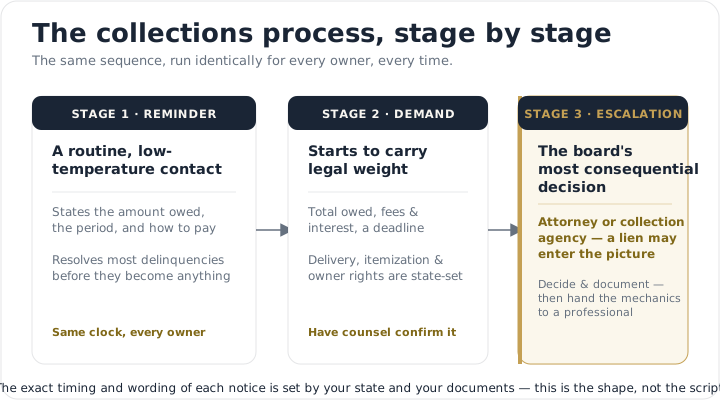
Most sound collection policies move through the same general arc. The exact timing, wording, and required contents of each notice are governed by your state's law and your own documents — so treat the stages below as a governance framework, not a legal template.
Stage one: the reminder
The first contact should be routine and low-temperature. An owner a few weeks past due is very often not a "delinquent owner" — they moved, changed banks, missed an email, or had a payment bounce. A friendly reminder that states the amount owed, the period it covers, and how to pay resolves a large share of delinquencies before they become anything. Send it the same way, on the same clock, for everyone. Don't skip the reminder for some owners and jump straight to threats for others — that inconsistency is precisely the pattern that gets boards into trouble.
Stage two: the formal demand
If the reminder goes unanswered, the process escalates to a formal written demand: a clear statement of the total now owed, any late fees or interest that have accrued under your policy, the deadline to bring the account current, and what happens if they don't. This is the notice that starts to carry legal weight, and it's where state variation gets sharp. Many states dictate how this notice must be delivered, how much it must itemize, how much time the owner must be given, and what the owner's rights are — including, in some states, a right to request a payment plan or to dispute the debt. Because the demand is often a prerequisite to everything that follows, this is a good point to have counsel confirm your template and your timeline.
Stage three: escalation
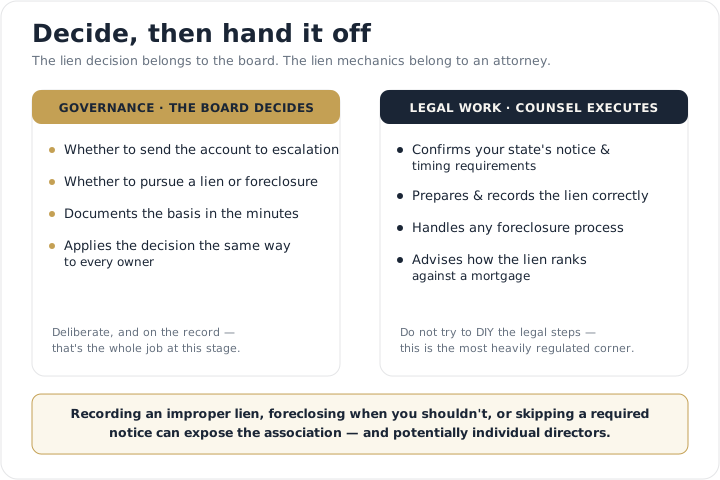
When a demand doesn't resolve the account, the board faces its most consequential decisions: whether to send the matter to an attorney or a collection agency, whether a lien enters the picture, and what other remedies your documents and state law allow. These steps have real cost and real legal exposure, and they are heavily regulated. The board's job is to make the decision to escalate deliberately, document it, and then hand the mechanics to a professional. Do not try to DIY the legal steps.
When a lien enters the picture
The phrase that makes collections feel high-stakes is the HOA lien for unpaid dues. In general terms, a lien is a legal claim recorded against the delinquent owner's property for what they owe the association; it can affect the owner's ability to sell or refinance, and in some circumstances it can be foreclosed. That is a serious remedy with serious consequences for a homeowner — and a serious liability if the association gets the process wrong.
Here is the honest part: how liens work is one of the most state-specific, most heavily regulated corners of community association law. Whether a lien arises automatically or has to be recorded; what notice the owner must receive first; how long you have to act; what the lien can include; where it ranks against a mortgage; whether and how it can ever be foreclosed — all of it varies dramatically by state, and some of it is shaped by federal law too. This post will not give you a timeline, a dollar threshold, a priority rule, or a step sequence, because there is no universal one, and a wrong number here is exactly the kind of mistake that turns a routine delinquency into a lawsuit against the board.
What a self-managing board should take from this is a boundary: the decision to pursue a lien or foreclosure is a governance decision the board makes and documents; the execution is legal work you route to an attorney licensed in your state. Recording an improper lien, foreclosing when you shouldn't, or skipping a required pre-lien notice can expose the association — and potentially individual directors — to liability. Before your board authorizes any lien or foreclosure action, get specific advice from counsel on your state's requirements and your own governing documents. (For a broader look at where directors are and aren't personally on the hook, see our post on HOA board member personal liability.)
Even-handed enforcement is the whole ballgame
If you take one idea from this post, take this: apply your collections process evenly, to every owner, every time. Collections and rule enforcement share the same fault line. The moment a board pursues one delinquent owner aggressively while quietly letting another slide — a friend, a board member's relative, an owner nobody wants to confront — it has handed the aggressively pursued owner a defense and handed the association a liability.
This is the same principle that governs rule enforcement, and the risks rhyme. An owner who can show the board went after them while ignoring identical delinquencies from others can challenge the board's action as unfair or selective. That's why the written policy and the documented, uniform process matter so much: they are your evidence that everyone was treated the same. If you want the full version of this argument in the rule-enforcement context, our posts on the HOA violation process and selective enforcement walk through it in detail — the logic transfers almost directly to collections.
Even-handedness also means handling hardship humanely and consistently. Many boards, and many states, allow or encourage payment plans for owners in genuine distress. If yours does, offer the same option, on the same terms, to every owner who qualifies — don't make it a favor you grant selectively. A payment plan that keeps a struggling owner current is usually better for the community than a foreclosure.
How the money problem connects to the whole budget
Delinquencies aren't just a collections problem; they're a budgeting problem. Every dollar not collected is a dollar your operating budget and reserves were counting on. When delinquencies pile up, boards often reach for a special assessment to cover the gap — which spreads the cost of the non-payers onto the owners who did pay. Tracking delinquencies early and acting on them consistently is part of how you avoid getting there.
Where BoardPath fits
Running collections evenly, and proving you did, is a documentation problem — and documentation is exactly what a small volunteer board struggles to keep up with by hand. That's the gap BoardPath is built to close.
BoardPath reads your association's own governing documents and answers what your CC&Rs, bylaws, and adopted policies say about assessments, late fees, and delinquency — with the source provision cited, so your collection policy is grounded in your documents rather than in what worked at some other community. It reads your governing documents and gives you cited, plain-English answers to "what does our own collection policy actually require here?" — so the same policy applies to every delinquent account the same way, and each step is documented rather than improvised. That even-handed, on-the-record discipline is exactly what protects the board, and tying every answer to your own documents keeps the process out of memory and guesswork.
What BoardPath does not do is give you legal advice or tell you your state's lien procedure — and neither should any software. It keeps your process consistent and documented against your own documents; your attorney handles the state-specific legal steps. That division of labor is exactly how a self-managing board stays out of trouble.
Want to see it work on your own documents? Book a demo or apply to the founding cohort.
This post is general governance information for HOA and condo board members, not legal advice. Collections, late fees, interest, liens, and foreclosure are governed by your state's statutes and your association's governing documents, and they vary widely. Confirm your specific process — and any lien or foreclosure action — with an attorney licensed in your state before you act.