The short answer
Yes, but rulemaking is a delegated, limited power rather than a blank check. The board's authority to adopt rules comes from the declaration and bylaws, which define the lane it may operate in, and operating rules sit at the bottom of the authority stack. A rule that genuinely contradicts a higher document is void from the moment it is adopted — not merely risky — and no amount of unanimous board agreement fixes it. If the CC&Rs already address the subject, changing it takes an amendment and an owner vote, not a board vote.
A self-managing board got tired of short-term rentals turning their quiet community into a rotating cast of weekend guests. So they did what boards do: they passed a rule. At the next meeting they voted in a 30-day minimum lease, published it to owners, and started enforcing it.
Months later, they sent a fine to an owner renting his unit by the week. He hired a lawyer. The lawyer pulled the CC&Rs, pointed to a clause that expressly permitted rentals with no minimum term, and explained the problem in one sentence: a board rule cannot override the recorded declaration. The rule wasn't merely weak. It had been void from the day it passed. The board hadn't just lost a fine — it had spent a year enforcing something it never had the authority to adopt.
So can an HOA make new rules? Yes. Boards adopt rules all the time, and most of them are perfectly enforceable. But rulemaking is a delegated, limited power — not a blank check. The boards that get burned aren't the ones that make rules. They're the ones that make rules they had no authority to make, or rules that quietly contradict a document that outranks them. Here is where the power comes from, where it stops, and how to adopt rules that actually hold.
Where your HOA board's power to make rules actually comes from
Your board does not have inherent authority to regulate the community. Its rulemaking power is delegated — it exists only to the extent the higher governing documents grant it. The declaration (CC&Rs) and the bylaws hand the board a defined lane to operate in. Day-to-day operating rules live at the bottom of the authority stack, and they cannot reach above their station.
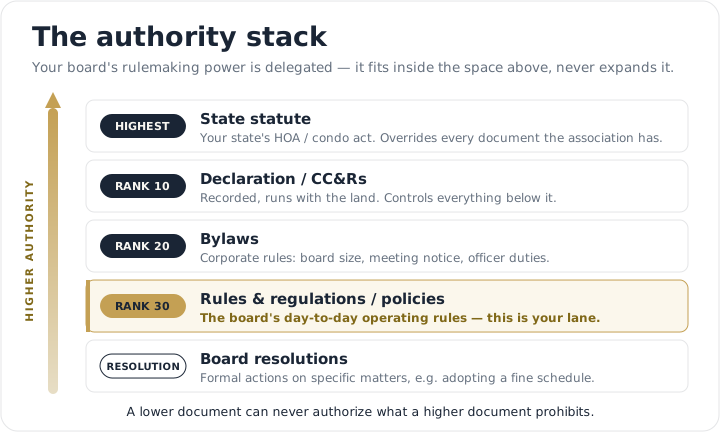
That stack is fixed, and every governing document sits at exactly one level:
- State statute — the highest authority. Your state's HOA or condominium act overrides every document the association has.
- Declaration / CC&Rs — the recorded document that runs with the land. Controls over everything below it.
- Bylaws — the corporate rules: board size, meeting notice, officer duties.
- Rules and regulations / policies — the board's day-to-day operating rules.
- Board resolutions — formal actions on specific matters, like adopting a fine schedule.
A lower-level document can never authorize what a higher-level document prohibits. That single sentence is the whole game — and it's worth seeing how the full hierarchy resolves a conflict when two documents disagree. Your rules have to fit inside the space the bylaws, CC&Rs, and statute leave open — they cannot expand it.
The first limit: a rule can never contradict a higher document
Here is the part that surprises new boards. A board-adopted rule that contradicts the CC&Rs is not "risky" or "probably unenforceable." It is void from the moment it is adopted — not voidable, void. The same is true for a bylaw that contradicts the statute. There is no grace period, no presumption of validity, and no amount of unanimous board agreement that fixes it.
This is the most common hierarchy mistake boards make, and it's exactly what happened in the rental example above. The board's rulemaking authority is delegated by the CC&Rs, and it cannot be used to contradict them. If the declaration permits something, a rule can't ban it. If the declaration prohibits something, a rule can't authorize it. The rule simply has no legal effect — and every action taken under it is exposed.
So when an owner asks "are HOA rules enforceable?", the honest answer is: only the ones that fit inside the authority the higher documents grant. A rule that stays in its lane is enforceable. A rule that wanders up the stack was never enforceable to begin with.
HOA rule vs. CC&R: when you need an amendment, not a rule
A lot of board frustration comes from trying to solve a CC&R-level problem with a rules-level tool. They don't fit.
If the issue you want to address is governed by the CC&Rs, you generally cannot change it by board vote — you change it by amending the CC&Rs, which typically requires an owner vote at a supermajority threshold spelled out in the documents, then recording the amendment against title. A board resolution that purports to amend a provision the documents reserve to an owner vote is void regardless of how the board feels about it.
The clean test for HOA rule vs. CC&R: ask what document already speaks to this?
- If the CC&Rs prohibit commercial vehicles, no board rule can authorize them. That takes a CC&R amendment — an owner vote, not a board vote.
- If the CC&Rs are genuinely silent and the bylaws leave the matter to the board, a rule is the right instrument.
- If your state statute already settles the question, the statute controls no matter what your documents or your new rule say.
One more wrinkle worth knowing: an amendment to a document inherits the rank of the document it amends. An amendment to the CC&Rs carries CC&R-level authority — it does not drop to the bottom of the stack just because it came later. So "we amended that" only resolves a conflict when the amendment sits at or above the provision it's competing with.

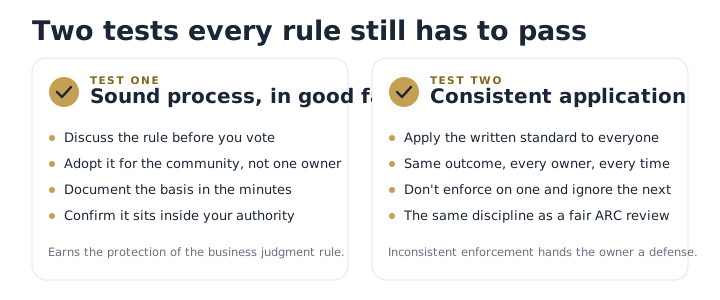
The two tests a rule still has to pass
Clearing the authority bar is necessary, but it isn't the whole job. Even a rule the board plainly has the power to make can still be challenged — and what saves it is how the board adopted and applied it.
Test one: sound process, in good faith. Boards earn legal protection for their decisions through the business judgment rule, which shields board members when a decision is made in good faith, on adequate information, in the association's best interest, and within the board's authority. For rulemaking, that means: discuss the rule before voting, adopt it for the benefit of the community rather than to target one owner, document the basis in the minutes, and confirm it sits inside your authority. A rule adopted through that process is far more defensible than one improvised in a single meeting.
Test two: consistency. A rule you enforce against one owner and ignore for the next is a rule you're likely to lose. The same principle that protects a well-run architectural review — applying written standards consistently, the same way for everyone — protects an operating rule. Inconsistent enforcement hands the owner a defense and undercuts the rule for the whole community — the trap covered in selective enforcement.
How "reasonable" a rule has to be, and the precise standard a court applies, varies by state. But the two tests above travel everywhere: adopt it the right way, and apply it the same way to everyone.
Can you make a rule retroactive?
This is one of the most common board questions, and the safest answer is the careful one. A new rule should govern conduct going forward. Trying to reach back and penalize something that was permitted — or quietly tolerated — when it happened is exactly where a retroactive HOA rule runs into trouble, both on consistency grounds and on the basic principle that a rule can't rewrite what a higher document already settled.
If you're introducing a rule for a situation that already exists in the community, the defensible move is to give clear, community-wide notice that the rule takes effect on a stated date, then apply it uniformly from there. Whether and how far a rule can apply to existing conditions is genuinely state-specific — confirm it against your statute, and run it past counsel before you enforce backward. (This article is information, not legal advice; the retroactivity question in particular turns on your state's law and your specific documents.)
A 60-second test before you adopt any rule
Before your board votes on a new rule, walk the stack from the top down:
- Does state statute address this? If yes, the statute controls — your rule has to match it.
- Do the CC&Rs address this? If yes, and there's no statute conflict, the CC&Rs control. A contradicting rule is void; a CC&R-level change needs an owner vote.
- Do the bylaws address this? If yes, and nothing above conflicts, the bylaws control.
- Are the documents silent and the matter operational? Then a board rule is the right tool — adopt it through sound process and apply it consistently.
The first "yes" you hit, starting from the top, is your controlling authority. If that answer isn't the rule you wanted to pass, you've just saved the board from adopting something unenforceable.
State variation — always check your own statute
The authority stack is the same in every state: statute over CC&Rs over bylaws over rules. What varies, sometimes significantly, is the content of each state's statute — which owner rights it protects, which procedures it mandates, and how it treats rule reasonableness and enforcement. Florida (FS 720 for HOAs, FS 718 for condos), California (the Davis-Stirling Act, Civil Code §4205), and Nevada (NRS 116) each codify the hierarchy and each impose their own specifics. Verify your state's current statute before concluding a rule is enforceable, and bring in counsel before adopting any rule that may touch CC&R-level owner rights.
You don't have to memorize your entire authority stack to adopt rules that hold. The hard part is knowing, in the moment, whether the rule you want to pass conflicts with something further up the chain — and then drafting the right instrument once you do. Ask whether a rule your board is considering is consistent with your governing documents, and the Boardroom answers in seconds — hierarchy-aware, with citations to the exact provision that controls. When the answer is "this takes more than a rule," BoardPath drafts the right vehicle for what your association is actually trying to do — a board rule, a motion, or a standalone policy when the matter is yours to decide, or, when it's CC&R-level, an amendment in proper form (always marked "DRAFT — for attorney review") — and prepares the owner mailing that goes with it. Sending that certified mailing, and handling the amendment ballot when a change requires a formal owner vote, are rolling out to our founding boards. Self-manage your community without flying blind on the one question that decides whether your rules are worth the paper they're printed on. See it in the live demo, or join the founding cohort.
This article is general information for self-managing boards, not legal advice. HOA and condo law varies by state and by the specific language of your governing documents. Confirm any statutory question against your current state statute and consult association counsel before acting.