The short answer
Running an HOA without a management company means owning nine recurring areas yourself: financial management and bookkeeping, dues and collections, insurance, reserves, vendor and contract management, board and annual meetings, minutes, violations and enforcement, and records and compliance filings. The financial track is where self-managed communities most often fail, so it comes first — reconcile every account monthly, keep operating and reserve funds in genuinely separate accounts, require dual signatures on reserve disbursements, adopt a budget before the fiscal year begins, and get an annual CPA review or audit. Full self-management fits best in small, simple communities, often under about 50 units and rarely above 75 to 100. The one transition mistake that does the most damage is terminating the management contract before the association's own bank accounts exist and the transferred funds have actually landed.
When a board decides to self-manage, the management fee disappears from the budget — and every job that fee was paying for lands on the board's desk. Most boards underestimate how long that list is. So before you make the call, it helps to see the whole job laid out: this is how to run an HOA without a management company, task by task, so you can decide with your eyes open and self-manage without flying blind. The good news is that thousands of small communities do it successfully. The difference between the ones that thrive and the ones that end up in a crisis is almost never enthusiasm — it's whether the board went in knowing exactly what it was taking on.
This is general information for board members, not legal advice. Many of the duties below are governed by your state's HOA or condo act and your own governing documents, and the specifics — notice periods, filing deadlines, reserve and audit thresholds — vary significantly from state to state. Confirm your state's current requirements before you rely on any of them.
First, an honest fit check
Self-management is a legitimate, workable model — but not for every community. It tends to work when the community is small (often under about 50 units, and rarely above 75–100, where the volume of decisions becomes a part-time job), when the assessment base can't comfortably absorb a management fee, when the board has the right skills and not just willing volunteers, and when the governance profile is simple — few amenities, no major deferred maintenance, a cooperative owner base. If that sounds like your community, the checklist below is your job description. If it doesn't, the hybrid model near the end may be the smarter path.
The self-managed HOA checklist: your recurring board duties
Here are the recurring self-managed HOA responsibilities — the work a management company was quietly doing every month. Treat this as your standing operations list.
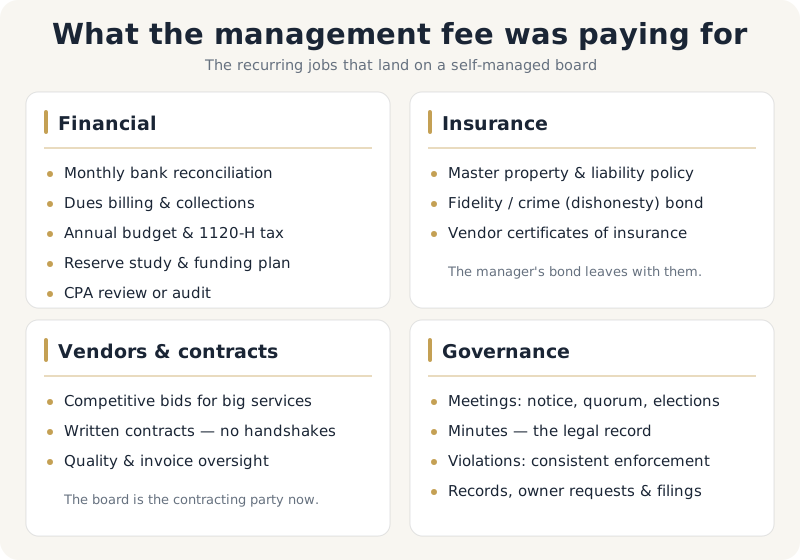
1. Financial management and bookkeeping
This is where self-managed communities most often fail, so it comes first.
- Reconcile every bank account monthly — operating and reserve accounts, separately, against the bank statement. A board member tracking this informally in a spreadsheet is not enough for a legal entity managing six or seven figures in common funds. Have the reconciliation reviewed by an officer other than the person who writes the checks.
- Keep operating and reserve funds in separate accounts. These are two legally distinct pools of money and must never commingle — even temporarily. Commingling breaches the board's fiduciary duty of care and is a serious audit finding — check your state's HOA or condo statute for how it treats this specifically.
- Require dual signatures on reserve disbursements. No single person should be able to move reserve funds alone.
- Run accounts payable — vendor invoices, utilities, insurance premiums — with formal board approval for anything outside the adopted budget.
- Prepare and adopt an annual budget before the fiscal year begins.
- File the federal tax return. Most associations file Form 1120-H (the HOA election), but it is not a simple return — the election rules and the treatment of exempt-function versus investment income call for a CPA who knows HOA taxation. The management company wasn't filing this; their CPA was. That relationship has to move to the association.
- Get an annual CPA review or audit. Many state statutes or governing documents require one above a revenue threshold; even where they don't, it's strongly recommended for any community holding meaningful reserves.
2. Dues, assessments, and collections
- Bill and collect assessments on schedule, and track who is current and who is behind.
- Follow a written collections policy for delinquencies — late notices, then the formal steps your documents and state statute allow. Liens and foreclosure are statute-heavy and consequential; loop in counsel before you escalate that far.
3. Insurance
- Source and renew the master policy (property and liability) every year, and adjust coverage as replacement costs change.
- Carry a fidelity/crime (employee dishonesty) policy. When you leave management, their bond — which covered their staff's access to your funds — goes with them. A common benchmark is coverage of at least three to four months of assessments plus the full reserve balance, with anyone who handles funds named. Small boards skip this because "we all know each other"; fidelity claims are actually more common in self-managed communities, precisely because the oversight structure is thinner.
- Collect a certificate of insurance (COI) from every vendor before work begins, and track effective dates so nothing lapses.
4. Reserves
- Commission a reserve study every three to five years and follow its funding plan. With no manager pushing it, self-managed boards quietly defer this — and a community with no current study can't know whether it's funded adequately or setting future owners up for a surprise special assessment. (For how much to set aside and why underfunding is a fiduciary issue, see our reserves guide.)
5. Vendor and contract management
- Solicit competitive bids for significant services — landscaping, snow removal, janitorial, maintenance.
- Sign written contracts with every provider. No verbal agreements: they leave the association with no recourse for substandard work and no record of what was agreed.
- Supervise work quality and invoicing. Once you self-manage, every contract runs in the association's name with the association's signature. The board is the contracting party now.
6. Board and annual meetings
- Send proper notice for every board and annual meeting — the timing is set by your state statute and bylaws.
- Run a valid annual meeting: notice, agenda, proxy collection, quorum confirmation, and the election procedure. (A meeting held without quorum can produce void elections and budgets.)
- Honor open-meeting rules — what can and can't be decided outside an open meeting is governed by state law.
7. Minutes — they're a legal record
- Produce minutes for every meeting, on time. Minutes aren't a courtesy; they're the association's official legal record of what the board decided. Capture the date, attendance, motions made, who moved and seconded, the vote outcome, and any action items — and keep them.
8. Violations and enforcement
- Run each violation through a documented escalation series — courtesy notice, formal notice, hearing notice, hearing, then any fine — with the timing and evidence your documents and statute require. Without the management company's workflow, boards let cases lapse or create due-process exposure.
- Enforce consistently. Enforcing against one owner while ignoring the same conduct elsewhere is how boards lose a dispute. (More on that trap in selective enforcement.)
9. Records, requests, and compliance filings
- Maintain the corporate records — governing documents, recorded amendments, minutes, contracts, financials, the owner roster — and respond to owner inspection requests. Record-access rights are commonly set by state statute, and getting a refusal wrong can trigger penalties — check your state's HOA or condo statute for the current rule.
- Respond to resale and estoppel requests from closing attorneys, often under statutory deadlines.
- File your state annual report / non-profit registration on time. Most associations are non-profit corporations, and in many states a missed filing can lead to administrative dissolution — the association loses its standing to assess, collect, lien, or litigate. Check your state's filing requirements and deadlines; treat them as non-negotiable.
The one-time transition checklist (before you leave)
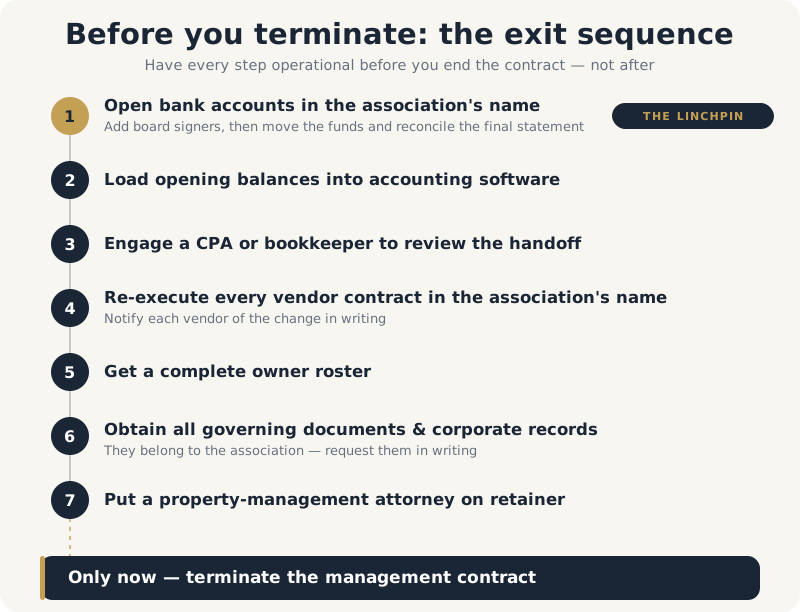
Everything above is the ongoing job. Getting out of your management contract cleanly is a separate, one-time project — and you should have all of this operational before you terminate, not after:
- Open association bank accounts in the association's legal name, add the board officers to signature authority, and transfer the funds. This is the linchpin. Under most management agreements the company holds signature authority on your accounts; terminate before your own accounts exist and the funds have landed, and you can be locked out of your own money on day one. Require a fully reconciled final statement and confirm it against your records before you sign off.
- Stand up accounting software with accurate opening balances loaded from that final reconciliation.
- Engage a CPA or bookkeeper before termination so they can review the opening-balance handoff with you.
- Reassign or re-execute every vendor contract into the association's name, and notify vendors in writing of the change.
- Get a complete owner roster (names, unit and mailing addresses, email, phone) — you can't send required notices without it.
- Obtain electronic copies of all governing documents and corporate records. These belong to the association, not the manager. Request them formally, in writing, with a deadline; some states set an express statutory timeline for their return, so check yours.
- Get a property-management attorney on retainer before the first legal question arises.
Self-manage without flying blind: the hybrid model
Full self-management isn't the only alternative to a management company. Many communities — especially in the 30–60 unit range — run a hybrid: the board handles vendor oversight, communications, meetings, and governance, while a part-time bookkeeper (often a few hundred dollars a month) covers monthly reconciliation, payables, and tax-return coordination, and an attorney on retainer is available by the hour for compliance and enforcement questions. That fills the two highest-risk gaps — financial management and legal compliance — while keeping most of the savings. The math often favors the hybrid until operational complexity clearly outgrows it.
Mistakes that sink self-managed boards
- Commingling operating and reserve funds. A fiduciary violation; keep the accounts separate from day one.
- Paying bills the board never approved. Even well-intentioned, it bypasses the board's oversight role. Material spending outside the budget needs a vote.
- No written vendor contracts. No paper, no recourse, no COI on file.
- Skipping the reserve study. With no manager pushing it, it slips — and the special assessment lands on a future board.
- No fidelity coverage. The thinnest-oversight communities are the ones that most need it.
- Treating state compliance as optional. Notice periods, open-meeting rules, records access, and election procedures are statutory obligations. A self-managed board is the compliance officer, with no manager to catch what it misses.
- Terminating before the bank transfer is confirmed. The single most common catastrophic transition mistake.
Knowing what the documents actually require sits underneath almost every item on this list — who has authority to spend, what notice the bylaws demand, whether a rule is even enforceable. (When two of your own documents seem to disagree, start with which document controls; before you adopt a new rule, check whether your board can legally make it; and for who owns which job, see board member roles explained.)
That cross-referencing is slow when it means reading the CC&Rs, bylaws, rules, and amendments side by side every time a question comes up — and it's only one line on the list above. BoardPath is built as the toolkit for the governance side of this whole checklist: cited, hierarchy-aware answers from your own documents, violations tracked through a consistent escalation series with a documented record, meeting minutes, owner letters and notices on your letterhead, and obligation reminders so the recurring deadlines don't slip. The standing operations work a manager used to carry, in one place, so a self-managing board runs the list confidently instead of guessing. See it in the live demo, or join the founding cohort.
<!-- Internal links above point to other blog drafts (which-hoa-document-controls, can-your-board-make-that-rule, selective-enforcement, hoa-board-member-roles-explained) and the /reserves and /demo and /apply pages. The blog links are 404-until-published — verify each target is live before this post goes public. -->