The short answer
A defensible architectural review runs the same four stages for every request: application on a single intake form, review measured against the written standards in the governing documents rather than personal taste, a written decision citing the specific standard it rests on, and a record kept at the time rather than reconstructed later. The committee's authority comes from the declaration, so a denial has to rest on a standard the documents actually contain — guidelines can add detail but cannot grant power the CC&Rs never gave. Watch the response deadline: under some statutes and many declarations, a request left unanswered within the required window can be treated as approved by default.
An owner painted their front door a deep navy blue. No complaints — until a different owner two streets over asked to do the same thing and got a flat "no." Now the board has a problem it can't easily explain: two owners, the same request, two opposite answers. The second owner isn't asking about paint anymore. They're asking why the rules apply to them and not their neighbor.
That is the trap the HOA architectural review process exists to prevent. For a self-managing board, architectural and modification requests — a fence, a shed, solar panels, a deck, a repaint — are where fairness gets tested most often, because every decision is visible, permanent, and sitting next to a neighbor's identical project. Run the process with a consistent workflow and a written record, and those decisions hold up. Run it on gut feel and you build the exact inconsistency an owner's attorney is trained to find. Here's how to run it right.
This article is general information for self-managing boards, not legal advice.
What the ARC is — and where its authority comes from
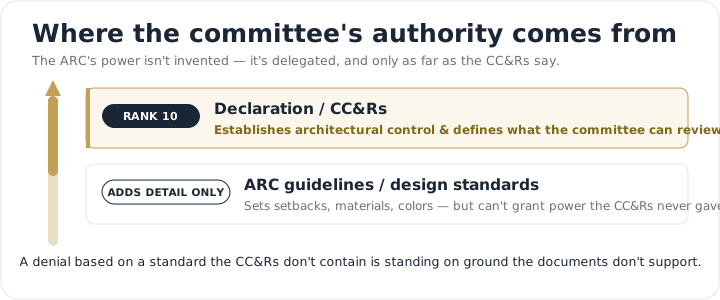
The Architectural Review Committee (ARC) — sometimes called the architectural control or modifications committee — reviews owner requests to change the exterior or structure of a property. On a small self-managing board, the "committee" is often just the board itself or a couple of appointed owners. The name matters less than the authority behind it, and that authority isn't something the board invents — it comes from your governing documents. The declaration (CC&Rs) is almost always where architectural control is established: the recorded document that says exterior changes require approval and defines what the committee can review. Any HOA ARC guidelines or design standards the board adopts sit below those documents — they add detail, but can't grant the committee power the CC&Rs never gave it. That order decides who wins when two documents disagree, the same authority stack that governs which document controls any governance question.
So the first move in any architectural matter isn't "what do we think?" It's "what do our documents actually let the committee require?" If your CC&Rs give the ARC authority over structural modifications but say nothing about paint colors, a denial based on color may be standing on ground the documents don't support. The committee's job is to apply the standard the documents set — not a stricter one it wishes they set.
How the HOA architectural review process works, step by step
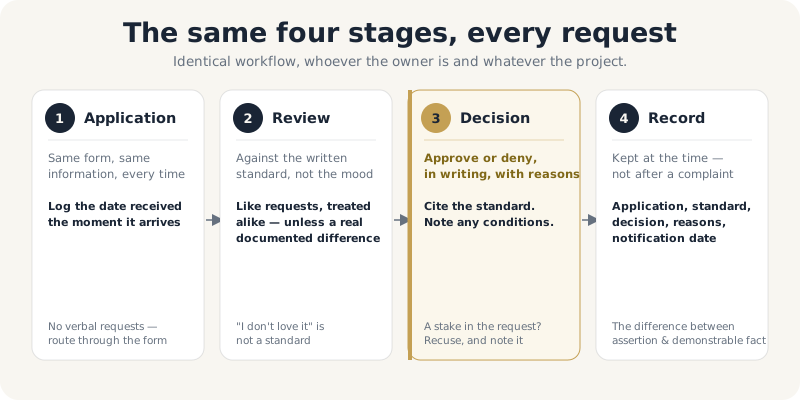
A defensible HOA architectural review process runs the same four stages for every request: application, review, decision, and record — identical every time, whoever the owner is and whatever the project.
1. Application — one intake, same information every time
Every architectural request should come in the same way, on the same form, asking for the same information. A workable HOA architectural request form captures:
- The owner's name, property, and contact information.
- A clear description of the proposed change.
- Drawings, a site plan, or a plat showing location and dimensions.
- Materials, colors, and finishes.
- Contractor information where relevant.
- The owner's signature and the date submitted.
A single intake path gives the committee enough to actually evaluate the request and timestamps the clock — you can't measure a reasonable response time against a hallway conversation. Log the date received the moment it comes in. Verbal requests are where fairness starts to leak; route everything through the form.
2. Review — apply the written standard, not the mood in the room
Review is where consistency is won or lost. The committee measures the request against the written standards in the governing documents and any adopted design guidelines — setbacks, height limits, approved materials, color palettes. The test for each element is simple: does our written standard address this, and does the request meet it?
Two habits protect the board here. Review against the document, not personal taste — "I don't love it" is not a standard, and a denial that can't point to a written provision is hard to defend. And treat like requests alike: if the committee approved a six-foot cedar fence last spring, the next one starts from that same answer unless there's a genuine, documented difference — a setback, an easement, a real factual distinction the committee can point to in writing.
3. Decision — approve or deny, in writing, with stated reasons
Every decision goes to the owner in writing, and a denial should state the specific reason tied to the specific standard. "Denied" on its own invites a dispute; "denied because the proposed fence exceeds the six-foot height limit in the CC&Rs" gives the owner something concrete — and often a path to a compliant resubmission. Good practice for the decision stage:
- Put HOA modification approval in writing — approvals as well as denials. An owner who builds on a verbal "sure, go ahead" and is later challenged is a problem for the board too, not just the owner.
- State the reason for a denial and cite the standard it rests on. Note any conditions on an approval (for example, a required rear-yard setback).
- Say what an approval does and doesn't cover — it's about design standards, not a substitute for a building permit or a guarantee the work meets code.
If a committee member has a personal stake in a request — their own project, or a next-door neighbor's — that member should step back from the decision and the recusal should be noted. A committee seat isn't a tool for a different answer than a neighbor would get.
4. Record — keep the file at the time, not after
Architectural disputes are decided on the record the board kept — and the one that wins is created when the decision is made, not after a complaint. For each request, keep the application, the date received, what the committee reviewed it against, the decision, the reasons and any conditions, and the date the owner was notified. Kept at the time, that file is the difference between "we treated everyone the same" as an assertion and as a demonstrable fact.
Reasonable timelines — and the risk of missing them
Owners are entitled to a decision within a reasonable time, and dragging a request out for months is its own kind of unfairness. Set a response window — many boards use 30 to 45 days from a complete application — publish it in your HOA ARC guidelines, and meet it every time. A timeline the committee ignores is worse than none, because now the inconsistency is documented.
There's a specific reason to take the clock seriously. Under some state statutes and many declarations, if the committee doesn't respond within the required window, the request can be treated as automatically approved — a project the board never reviewed, approved by default because the deadline passed in silence. Whether that "deemed approved" rule applies, and how long the window is, varies by state and by your documents. Check your state's HOA or condo statute and your own CC&Rs for any response deadline, confirm with counsel if you're unsure, and until you know, treat every complete application as if the clock is running — because it may be.
Why even-handed, documented decisions protect the board
Here is the part that turns architectural review from an annoyance into risk management. The same principle that governs selective enforcement governs architectural decisions: the fastest way for a board to lose is to treat two similar situations differently with no documented reason why. An owner denied a project their neighbor was allowed to build has the beginnings of a real claim — not because the board was wrong about the standard, but because it applied that standard unevenly. Consistency closes that door: when the committee runs the identical workflow for every request and keeps a file showing it did, the distinctions it can defend are the documented ones — the easement, the setback, a genuine factual difference.
Authority can't outrun the documents, either. Just as a board can't make a rule that contradicts a higher document, a committee can't deny a request on a standard the CC&Rs don't contain. A denial has to rest on real, written authority — which is why knowing what your own documents say, before you answer an owner, is the whole game.
State variation — check your documents and your statute
How much discretion a committee has, what timelines apply, whether a missed deadline means automatic approval, and how "reasonable" a standard has to be all vary — sometimes significantly — by state and by the language of your governing documents. Some states also give special protection to certain modifications, which can limit what a committee may restrict regardless of what the CC&Rs say. This article can't tell you what your rules are — only how to run a fair process within them. Read your CC&Rs to confirm the committee's actual authority and any response deadline, check your state's HOA or condo statute for owner protections and timelines, and bring in your association's attorney when a request touches a legally protected modification, when an owner's lawyer gets involved, or when a denial could become a real dispute. Where your documents and your statute set a more protective process for the owner, that's the one that controls.
The takeaway for self-managing boards
A fair HOA architectural review process isn't about having the best taste on the board. It's about running the same four steps — application, review, decision, record — for every owner, measuring each request against the written standard, and keeping the file while you do it. Get that right and the navy-blue-door problem never happens, because the answer to "why them and not me?" is always the same document, applied the same way. It comes down to two things: knowing what your documents authorize, and keeping a record of how you applied them.
BoardPath's Boardroom handles the first — ask "what does our declaration let the architectural committee require?" and it answers in seconds, with citations to the exact provision, so a denial rests on real authority instead of a hunch. When a decision is made, BoardPath drafts the owner's approval or denial letter on your association's letterhead, reason and governing provision stated plainly — so the record is built the moment the decision is, not reconstructed after a complaint lands. Self-managing your community doesn't have to mean guessing at what your documents allow. See it in the live demo, or join the founding cohort.
This article is general information for self-managing boards, not legal advice. HOA and condo law varies by state and by the language of your governing documents. Confirm any question about architectural authority or response deadlines against your current state statute and your own CC&Rs, and consult association counsel before denying a request that could become a dispute.