The short answer
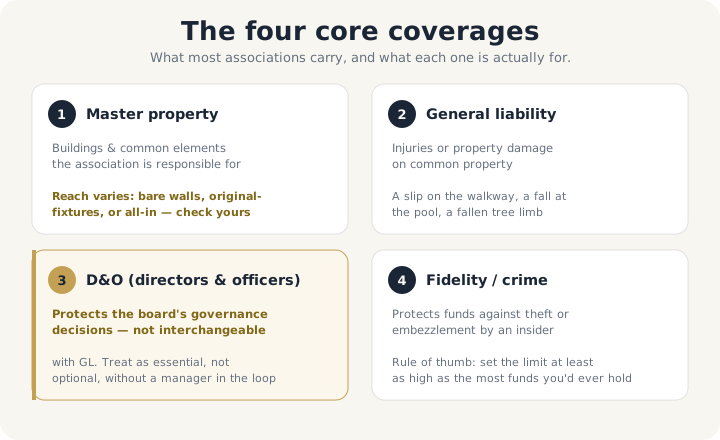
Most associations carry four things: a master property policy for the buildings and common elements, general liability for injuries or damage on common property, directors-and-officers coverage protecting board volunteers against governance claims, and fidelity or crime coverage protecting association funds against theft. What is actually required comes from two sources that do not always match — your own governing documents and your state's statute. General liability and D&O are not interchangeable, and where the master policy stops and an owner's HO-6 begins depends on whether the master is bare-walls, original-fixtures, or all-in. The recurring risk for a self-managing board is simply losing track: a renewal that slides, a vendor certificate that expired, a fidelity limit that no longer matches the reserves held.
This article is general governance education, not legal or insurance advice. HOA insurance requirements come from two places at once — your state's condo or HOA statute and your association's own declaration and bylaws — and they vary widely from community to community. Before you buy, renew, or change a policy, read your own governing documents and confirm the specifics with a licensed insurance broker who knows community associations, and with counsel where a legal question is involved.
When a board runs its community without a management company, insurance is one of the areas where a quiet gap can turn into a very loud problem. A management company usually kept the renewal calendar, collected certificates from vendors, and knew which policies the documents demanded. Take that role in-house and the responsibility lands squarely on the board — which means understanding HOA insurance requirements well enough to ask the right questions, even if a broker handles the placement.
You do not need to become an underwriter. You do need to know the handful of coverage types every association typically carries, where the requirement to carry them comes from, and how the association's coverage fits together with what individual owners insure themselves. This guide walks through each piece in plain English.
Where HOA insurance requirements actually come from
Here is the first thing that trips up new boards: there is no single national rulebook for association insurance. Two separate authorities can each impose requirements, and they don't always match.
- Your governing documents. Most declarations (CC&Rs) and bylaws contain an insurance article that spells out what the association must carry — often a master property policy, liability coverage, and sometimes fidelity and directors-and-officers coverage. This is binding on your board. It is also the most specific instruction you have, so start here.
- Your state's statute. Many states set baseline insurance obligations for condominiums and, in some states, for HOAs — but the details differ enormously by state, and some states say far more than others. Whether your state mandates a particular coverage, a minimum limit, or a specific deductible allocation is a state-by-state question. Check your state's condo or HOA statute, and confirm with counsel or your broker.
When the two disagree, that is a question for counsel, not for a board vote. The practical takeaway: read your insurance article first, then have your broker confirm what your state layers on top. Don't assume the last policy the association bought was correct just because it renewed year after year.
The core coverages, in plain English
Most associations carry some combination of the following. Your documents and your state may require more or fewer.
The HOA master insurance policy (property)
The HOA master insurance policy is the association's property coverage on the buildings and common elements it is responsible for. In a condominium, this often covers the structure itself; in a townhome or single-family HOA, it may cover only shared structures like a clubhouse, pool house, mailbox kiosks, or fencing.
The detail that causes the most owner confusion is how far in the master policy reaches. Some policies cover the units "as originally built" (original fixtures and finishes); some are "bare walls" (structure only, nothing inside the unit); some are "all-in." Which one applies to your association is defined by your declaration and the policy itself — and it directly determines what each owner has to insure. Know your master policy's reach before an owner asks, because they will ask after a burst pipe, not before.
General liability
General liability responds when someone is injured on common property or the association is blamed for property damage — a slip on an icy walkway, a fall at the pool, a tree limb that comes down on a car. For a self-managing board, this is foundational coverage; common areas are the association's responsibility, and injuries happen there.
Directors and officers (D&O) insurance
HOA D&O insurance protects the volunteers on the board — and often committee members — against claims arising from their governance decisions. If an owner sues the board over an architectural denial, an election dispute, a rule the board adopted, or an enforcement action, D&O is the policy that responds to defense costs and covered claims. General liability handles bodily injury and property damage; D&O handles the "you made a bad decision" claims. They are not interchangeable, and a self-managing board should treat D&O as essential rather than optional.
D&O matters even more when there is no management company in the loop, because the board is making and documenting more decisions directly. Confirm the policy covers the specific kinds of claims volunteer boards actually face, and review the limits with your broker. For a fuller look at how board members can be exposed personally and how insurance and good process reduce that exposure, see our guide to HOA board member personal liability.
Fidelity / crime coverage
Fidelity coverage (sometimes called crime or employee-dishonesty coverage) protects the association's money against theft or embezzlement by someone with access to the funds — a board officer, a bookkeeper, or a manager. When a volunteer treasurer is signing checks and moving money between operating and reserve accounts, this coverage is the association's backstop against internal loss.
A common rule of thumb brokers use is to set the fidelity limit at least as high as the maximum funds the association could hold at any one time — including reserves. Your governing documents or your state may speak to a minimum; some do, many don't, and the amount that's actually prudent depends on how much money you hold. Because reserve balances drive that number, revisit your fidelity limit whenever your reserve funding changes materially — the same balances your reserve study tracks.
How the master policy meets the owner's HO-6
This is the single most misunderstood part of association insurance, so it's worth being precise.
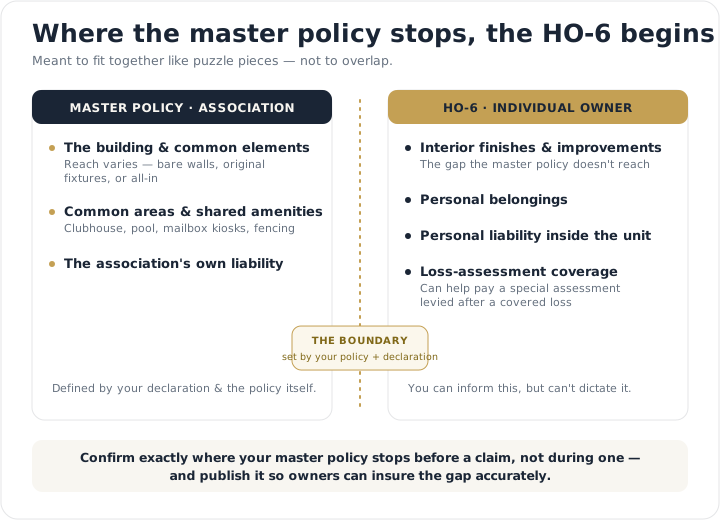
The association's master policy and an individual owner's policy are meant to fit together like puzzle pieces, not to overlap. In a condominium, owners typically buy an individual HO-6 unit-owner policy to cover the gap the master policy leaves — things like interior finishes and improvements the master doesn't reach, personal belongings, personal liability inside the unit, and often loss assessment coverage (which can help an owner pay a special assessment levied after a covered loss).
Where exactly the master policy stops and the HO-6 begins depends on your master policy's reach (bare walls vs. original-fixtures vs. all-in) and on your declaration. Two practical points for a self-managing board:
- You can't dictate owners' HO-6 coverage, but you can inform it. Many boards ask owners to carry an HO-6 and to name the association as an interested party, and they publish a plain-language summary of where the master policy stops so owners can insure the gap accurately. Whether you can require it — and how — is governed by your documents and state law; confirm before you mandate.
- Deductible allocation is a real question. When the master policy has a large deductible, who pays it after an owner-originated loss — the association or the owner — is set by your documents and sometimes by statute. Get clarity on this in calm weather, not during a claim.
Vendor certificates of insurance (COIs)
Every vendor who sets foot on association property — landscapers, roofers, pool contractors, snow removal, painters — should provide a current HOA certificate of insurance before work begins. A COI is a one-page proof-of-coverage summary from the vendor's insurer. Collecting it is one of the plainest ways a self-managing board protects the association from picking up liability that belongs to a contractor.
When a COI arrives, check the parts that actually matter:
- The coverage types and limits are adequate for the work (a roofer working at height is a different risk than a monthly landscaper).
- The policy dates are current — an expired COI is no protection at all, and this is the item most likely to lapse quietly.
- The association is named as an additional insured where appropriate, so the vendor's policy responds if the association is pulled into a claim arising from the vendor's work.
- Workers' compensation is shown where the vendor has employees.
The failure mode isn't usually collecting the first COI — it's letting it expire. A vendor you've used for three years may have dropped coverage last spring, and you won't know unless you re-collect at renewal. Build a simple tickler so every active vendor's COI gets refreshed on schedule.
Why continuity matters during a management transition
If your board is picking up self-management from a departing management company, insurance is one of the first places to look and one of the easiest to drop. Coverage that lapses even briefly can leave the association exposed for exactly the window it's least prepared to handle a claim.
Before the transition date, confirm you have in hand: the current policies and their declarations pages, the renewal dates for each, the broker or agent of record and how to reach them, and the full COI file for active vendors. A short lapse in D&O or property coverage during a handoff is the kind of gap nobody notices until there's a claim — and by then it's too late to backdate. Treat "who owns each renewal date now" as a named task with a named owner, the same way you'd treat any other item on a self-managed board checklist.
Bringing it together
HOA insurance requirements aren't as complicated as they first look once you separate the questions: What must we carry? (documents + state), What does each policy actually cover? (property, liability, D&O, fidelity), Where does the association's coverage stop and the owner's begin? (master vs. HO-6), and Are our vendors covered? (current COIs, named additional insured). Answer those four, keep the renewal dates from slipping, and you've closed the gaps that catch most self-managing boards.
The recurring risk is simply losing track — a renewal that slides, a COI that expired, a fidelity limit that no longer matches the reserves you hold. That's the tracking a management company used to do, and it's exactly where BoardPath helps: it reads your governing documents and gives you cited, plain-English answers to "what does our declaration require us to insure?", and it keeps your insurance renewals and vendor COI dates as tracked obligations so a renewal or COI date doesn't slip past the board unnoticed. You stay the decision-makers; the calendar and the document-reading stop being something you have to hold in your head.
Want to see how that looks against your own documents? Take the demo or apply to the founding cohort.
BoardPath is governance intelligence for self-managing HOA and condo boards. It surfaces what your governing documents and state require and tracks the obligations that keep a board compliant — it is not an insurance policy, an insurance broker, or a substitute for legal or insurance advice. For coverage decisions, work with a licensed broker and, where a legal question arises, your association's counsel.