The short answer
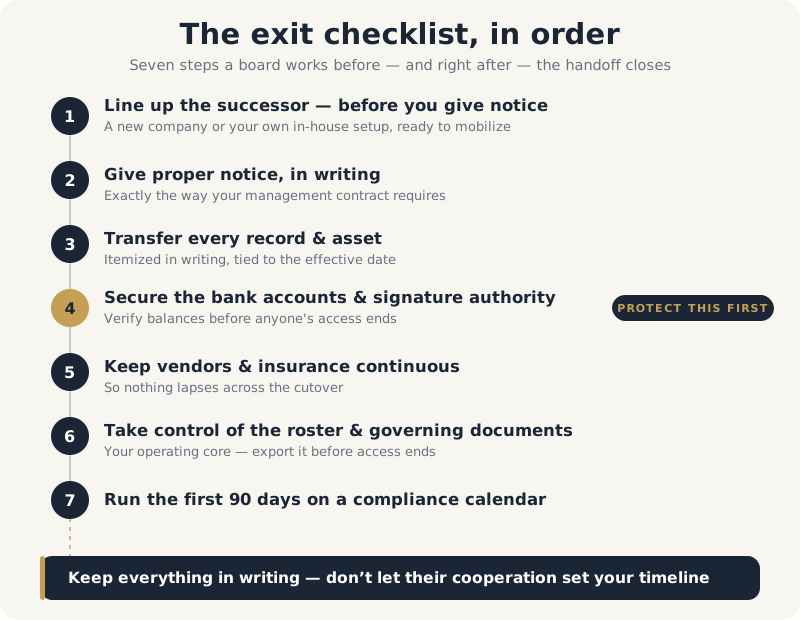
A clean exit runs seven tracks toward one effective date: line up the successor before giving notice, give written notice exactly as the contract requires, transfer every record and asset against a written itemized list, secure the bank accounts and signature authority, keep vendors and insurance continuous through the cutover, take control of the owner roster and governing documents, and run the first ninety days on a compliance calendar the board controls. Everything the outgoing company holds belongs to the association, which is only its custodian. Protect the money first — verify the operating and reserve balances in writing and add a board signer directly with the bank before the outgoing manager's access ends.
Deciding to leave your management company is the easy part. The hard part is the handoff — the weeks when the outgoing company still holds your bank accounts, your reserve funds, your records, and every login your community runs on. This HOA management transition checklist is the board-side plan for that handoff: what to collect, what to protect, and what to stand up so your community never skips a beat. Whether you're switching HOA management companies or moving the work in-house, the mechanics are the same — get them in order and the change is clean instead of chaotic.
A transition is one of the highest-risk operational events a volunteer board can trigger, precisely because so much of the association's value sits in someone else's custody on the day you make the change. Boards that treat it as a checklist get through it well. Boards that treat it as a phone call tend to spend the next six months untangling things that a single afternoon of planning would have prevented.
This is general information for board members, not legal advice. Contract terms, notice periods, and records-return obligations vary significantly by state and by your specific management agreement. Check your own governing documents and your state's HOA or condo statute, and confirm anything consequential with counsel before you act.
The HOA management transition checklist at a glance
Before the detail, here's the shape of the whole thing. A well-run HOA management company transition runs on parallel tracks, all converging on one effective date:
- Line up the successor — a new company or your own in-house setup — before you give notice.
- Give proper notice in writing, exactly the way your contract requires.
- Transfer every record and asset the association owns, itemized in writing.
- Secure the bank accounts and signature authority and confirm balances.
- Keep vendors and insurance continuous so nothing lapses across the cutover.
- Take control of the owner roster and governing documents — your operating core.
- Run the first 90 days on a compliance calendar you control.
The rest of this post walks each one. Work them in order, keep everything in writing, and don't let the outgoing company's cooperation — which tends to cool the moment notice lands — become the thing your timeline depends on.
Line up the handoff before you give notice
The single most common mistake is notifying the incumbent before the replacement is ready. Cooperation drops the day notice arrives, so the receiving side — whether that's a new management company or your own board — has to be able to mobilize immediately.
If you're switching HOA management companies, run a real selection: a written scope, an itemized fee schedule rather than "standard rates," references from communities like yours that you actually call, and an interview with the specific manager who will be assigned. One step boards skip is verifying licensure where it applies — some states license community managers and others don't, so check your state's rules and confirm any required license at the state's own database rather than a copy the company hands you.
If instead you're planning a self-managed HOA transition, that same lead time goes into standing up bank accounts, bookkeeping, insurance, and a compliance calendar before you terminate. Our companion guide on what actually changes when a board self-manages covers the day-to-day shift in more depth.
On notice itself: your right to end the relationship lives in the contract, not in a blanket rule. Most management agreements spell out a notice period, a delivery method, and any for-cause terms — and those specifics are whatever your agreement says, which is why the first move is to read it. General practice that tends to hold up: notice should be written and delivered with confirmation of receipt, and the written notice is what starts the contractual clock, so build your timeline backward from the effective date. Requirements vary by contract and by state, so confirm yours before you send anything.
The records-and-assets transfer: it all belongs to the association
The governing principle makes the whole handoff simpler: as a general rule, everything the management company holds belongs to the association. The company is a custodian, not an owner. Put the return in a written, itemized transfer list tied to the effective date — not vague "return all records" language that lets the outgoing company decide what comes back.
What the list should cover:
- Financial records — bank statements for the full management period, the check register and ledgers, budget-to-actual reports, unpaid invoices and payables, any completed audit or review, tax filings, and the delinquency and collection ledgers.
- Owner records — the complete homeowner roster with names, units, mailing and email addresses, and phone numbers; individual account balances and payment history; active violation files; and architectural review applications.
- Governing documents — CC&Rs, bylaws, rules, and all recorded amendments; board minutes and resolutions; homeowner correspondence; insurance policies and current certificates; and any pending claims.
- Vendor and property records — every vendor contract the association is a party to, vendor contacts and insurance certificates, equipment warranties, maintenance logs, and capital records.
- Physical assets and digital credentials — keys, access cards, fobs, and gate or alarm codes, plus logins for every platform run on the association's behalf: management software, the owner portal, accounting, association email, website admin, the P.O. box, and any community social accounts.
Get the itemization into the termination notice itself. Without a written list, the party holding the records controls what actually comes back.
Bank accounts and signature authority: protect the money first
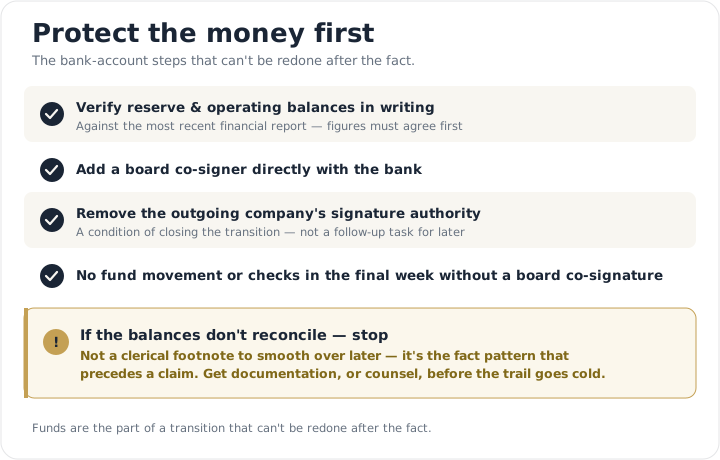
If you take one thing from this HOA management transition checklist, make it this: secure the money before the outgoing manager's access ends. Funds are the part of a transition that can't be redone after the fact.
- Verify the reserve and operating balances in writing against the most recent financial report. The figures must agree before you release anyone from the process.
- Add a board co-signer directly with the bank. The board can do this independent of the management company's cooperation — the accounts belong to the association.
- Remove the outgoing company's signature authority as a condition of closing the transition, not a follow-up task for later. The same goes for any online banking and bill-pay access.
- Don't let the outgoing manager move funds or issue checks in the final week without a board co-signature.
- If the balances don't reconcile, stop. An unexplained discrepancy is not a clerical footnote to smooth over after the manager is gone; it's the fact pattern that precedes a claim. Get documentation — or counsel — before the trail goes cold, not after.
Vendors and insurance: keep continuity from day one
The point of continuity work is that homeowners should never notice the change happened. Landscaping still shows up, the pool still opens, and a claim can still be filed on day one.
- Contact every active vendor with the new billing and point-of-contact information, and confirm each contract is with the association, not personally with the management company. Where a contract ran through the manager, arrange assignment or a fresh agreement so service doesn't lapse.
- Confirm insurance is continuous. Make sure the association's own policies — property, general liability, directors-and-officers, and any others — stay in force through and past the cutover, with the association (not the manager) as the named insured, and update the contact and billing details. If the outgoing company carried any coverage on the association's behalf, close that gap before the effective date, not after.
- Redirect the mail and payments. Assessment payments sent to the old portal after cutover create avoidable delinquency disputes and frustrated owners who did exactly what they were told. Getting the payment instructions right is the single most impactful continuity step you'll take.
The owner roster and governing documents: your operating core
Two categories deserve special attention because everything else runs on them.
The owner roster is the association's operating spine — billing, notices, elections, and violation tracking all depend on it. Get it as clean, exportable data (a spreadsheet), not a locked report inside software you're about to lose access to. Confirm it's complete and current before access ends.
The governing documents are the board's binding authority, and a transition is when boards discover how much the manager quietly carried in their head. Collect the CC&Rs, bylaws, rules, and every recorded amendment — the amendments matter as much as the originals, because a rule you're enforcing may have been changed years ago. When two documents seem to conflict, remember the general order of authority: your state's statute sits above your CC&Rs, which sit above your bylaws, which sit above board rules and policies. (Which document controls a specific question, and how your state's statute interacts with it, still depends on your own documents and law — when it's consequential, confirm with counsel.)
Your first 90 days self-managing
Once the handoff closes, the work shifts from transferring to operating. The first quarter is about proving to yourselves that the community runs without a management company holding the pieces together.
- Stand up a compliance calendar — annual meeting timing, assessment billing, insurance renewals, reserve contributions, tax filing, and any state-required filings — with owners and due dates the board actually controls.
- Confirm the money is flowing — assessments landing in the association's accounts, bills paid on time, and a monthly reconciliation the whole board can see.
- Answer the governance questions in-house. The notice periods, quorum rules, and enforcement steps the manager used to recite now have to come from your own documents.
For a fuller runway, our self-managed board checklist lays out the functions a board takes on, and the how-to-fire guide covers the exit mechanics in detail if you're still deciding. The self-managed stack rounds it out with the categories of tools that replace what the manager used to handle.
When to call counsel
Most transitions resolve cleanly. A few moments genuinely call for a lawyer first:
- Before signing any termination or transition agreement — it should address records return, fund transfer, contract assignments, and a release of claims.
- If the outgoing company refuses to return records or delays account access. Records custody is generally treated as belonging to the association independent of the management contract — but confirm the specifics under your own state's statute, and know that an attorney's demand carries weight a board letter may not.
- The instant reserve or operating balances can't be reconciled, or funds moved without authorization. Engage counsel when the discrepancy appears, not after the transition closes.
The question a transition forces
A management exit forces a question many boards have never had to answer on their own: what do our own documents actually require? The manager knew the notice periods, the quorum rules, and the enforcement steps — and on the effective date, that knowledge walks out the door. The records come back in a box; the judgment about what they mean does not.
Two things help right at the handoff. For the notice itself, our free transition notice builder (Beta) reads your signed management agreement and drafts a notice of termination or non-renewal from what your contract appears to say — the notice period, delivery method, and deadline it identifies, which you confirm before download — instead of a template guessing at what your agreement requires. It's free and available now at /tools#transition-toolkit.
Then, for everything after the box arrives, that's the gap BoardPath was built to close. Upload your CC&Rs, bylaws, rules, and amendments, and you've picked up the governance functions the manager used to run: the Boardroom answers questions from your own documents — ranked in the correct order of authority, statute over CC&Rs over bylaws over rules, with a citation to the exact provision — alongside violations tracking, meeting minutes, and owner letters and notices on your letterhead, all at one flat price for any size community. A board leaving management doesn't have to leave the system behind. See it in the live demo, or join the founding cohort if you'd rather run your community confidently than guess the week after the manager who used to know walks out the door.