The short answer
The association's underlying obligations do not change when a board self-manages — only who does the work. What gets harder is mostly time: board members absorb after-hours calls, recurring administrative tasks, and the mental load a manager used to carry. What gets better is mostly money and visibility: the management fee stays in the community, and the board sees every dollar and every document directly rather than through a manager's dashboard. The hardest single function to replace is the institutional memory — knowing where everything lives and which document controls when the CC&Rs, bylaws, and rules do not quite agree — and most boards still pair the treasurer with a part-time bookkeeper rather than doing all the reconciliation in-house.
Every board that seriously considers self-management eventually asks the same quiet question: what does Monday actually look like after the manager is gone? Not the pitch, not the pros-and-cons list — the actual mechanics of who answers the phone, who reconciles the checkbook, and who remembers that the insurance renewal is due. That gap between "we could save the fee" and "we know exactly what we're taking on" is where most boards stall. It's also the wrong reason to stall, because the honest answer to self-managed HOA vs. management company isn't scary — it's just specific. This post walks through the real functions, one at a time, and tells you plainly what changes.
This is general information for board members, not legal advice. Which duties are governed by state statute, and how, varies significantly by state — check your state's HOA or condo statute and your own governing documents, and confirm anything with real legal or financial consequences with counsel.
The honest frame: some things get harder, some things get better
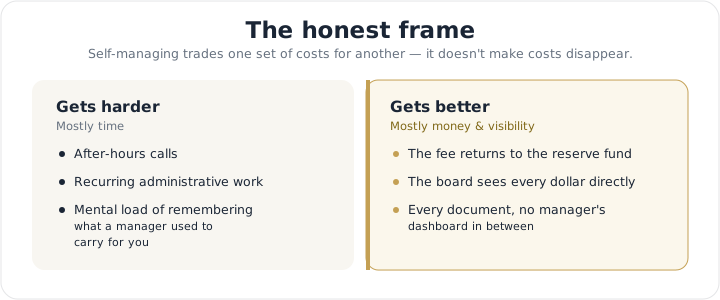
Before the function-by-function breakdown, the fair summary. Self-managing genuinely trades one set of costs for another — it doesn't make costs disappear. What gets harder is mostly about time: board members absorb after-hours calls, recurring administrative work, and the mental load of remembering what a manager used to remember for you. What gets better is mostly about money and visibility: the fee comes back to the reserve fund, and the board sees every dollar and every document directly instead of through a manager's dashboard. Neither side of that trade is the villain here — the fee itself, and the opacity that sometimes comes with it, is what boards are actually reacting against, not the manager as a person. Plenty of management companies do this work well and earn every dollar. The question is only whether your board wants to do it instead.
Dues collection and bookkeeping
What the manager did: invoiced assessments, tracked who paid, ran the delinquency process, reconciled the operating and reserve accounts monthly, and pulled together the numbers for tax prep and the annual budget.
What the board picks up: someone has to own the calendar — invoices go out on time, payments get tracked, and the books get reconciled every single month without a gap. This is the function where sloppiness turns into real risk fastest, so most boards pair the treasurer's oversight role with a part-time bookkeeper rather than trying to do it entirely in-house.
What a tool absorbs: HOA-specific accounting software replaces the spreadsheet chaos that causes most reconciliation errors, and keeps a clean audit trail if a question ever comes up. It doesn't replace the bookkeeper — it makes the bookkeeper's job faster and the board's oversight easier.
What's genuinely harder: finding and vetting a bookkeeper you trust with the checkbook, and sitting through the learning curve of your first few closes.
Vendor coordination
What the manager did: solicited bids, negotiated and filed contracts, scheduled routine maintenance, and was the point of contact when a certificate of insurance lapsed or a contractor no-showed.
What the board picks up: direct vendor relationships. This is more phone calls than most volunteers expect — and it's also where self-managing boards consistently report real savings, because there's no management markup between the invoice and the board.
What a tool absorbs: a shared vendor log with contract dates, insurance expiration, and contact info catches the classic miss — a lapsed certificate nobody notices until there's a claim.
What's genuinely better: direct leverage. When the board negotiates its own bids, it sees the real market price instead of a bundled rate.
Violations and ARC
What the manager did: fielded the complaint, documented the violation, sent the notice on schedule, tracked the escalation timeline, and reviewed architectural requests against the community's standards — the same way for every owner.
What the board picks up: the whole cycle, including the part that's hardest to do consistently: treating a friend on the board and a stranger down the street identically. Many states require some form of notice and an opportunity to be heard before certain enforcement steps — the specifics vary by state and by your own governing documents, so confirm both before acting, and loop in counsel on anything monetary.
What a tool absorbs: a documented, repeatable escalation sequence and a clean record of every step taken, for every owner — the exact evidence that protects a board from a selective-enforcement claim.
What's genuinely harder: the social discomfort of enforcing a rule against a neighbor with no manager standing between the board and the owner.
Meetings and minutes
What the manager did: prepared agendas, mailed notice on time, gathered materials, and drafted minutes that hold up as the association's legal record.
What the board picks up: the secretary role carries this, and it's genuinely learnable — the skill is discipline more than expertise. Minutes record what was decided, not what was discussed.
What a tool absorbs: a consistent template and a motion-recording workflow closes most of the gap a manager used to fill here, so minutes come out the same quality meeting after meeting instead of depending on who happened to take notes.
What's genuinely better: the board controls its own record instead of waiting on a manager's turnaround time to see the minutes from last month's meeting.
Owner communications
What the manager did: answered the phone, responded to email, sent community-wide notices, and buffered the board from 40 to 200 individual owners with individual questions.
What the board picks up: volume. This is the function that surprises self-managing boards the most — not the difficulty of any one answer, but the sheer number of them.
What a tool absorbs: cited answers pulled directly from the governing documents mean the board isn't reconstructing the same answer from memory every time a new owner asks the same question.
What's genuinely harder: responses won't feel as instant as a management company's office line — owners generally accept that trade if the answers stay clear and consistent, but it's a real adjustment on both sides.
Records and compliance
What the manager did: kept the corporate records straight — governing documents, amendments, minutes, correspondence, the owner roster — and tracked recurring compliance obligations the association can't afford to miss.
What the board picks up: the institutional memory. The manager's real value here was rarely expertise in any one document — it was knowing where everything lived and which document controlled when the CC&Rs, bylaws, and rules didn't quite agree.
What a tool absorbs: this is fundamentally a retrieval problem, not a judgment-call problem — which makes it the piece a tool is best positioned to replace. Hierarchy-aware, cited answers from the association's own documents do most of what a manager's memory used to do.
What's genuinely better: nothing lives in one person's head anymore. When a board member rotates off, the knowledge doesn't leave with them.
Insurance and reserves
What the manager did: confirmed the master policy and fidelity bond stayed current, collected certificates of insurance from vendors, and tracked the reserve study's funding schedule against what had actually been set aside.
What the board picks up: a standing calendar someone actively owns — renewal dates and funding milestones don't run on a mental note.
What a tool absorbs: recurring, tracked reminders do most of the work a manager used to do by habit, so a renewal date doesn't quietly slip past everyone.
What's genuinely harder: the association needs its own fidelity/crime coverage once the manager's bond no longer covers the funds board members can access — that's a real, new line item, not a hidden one.
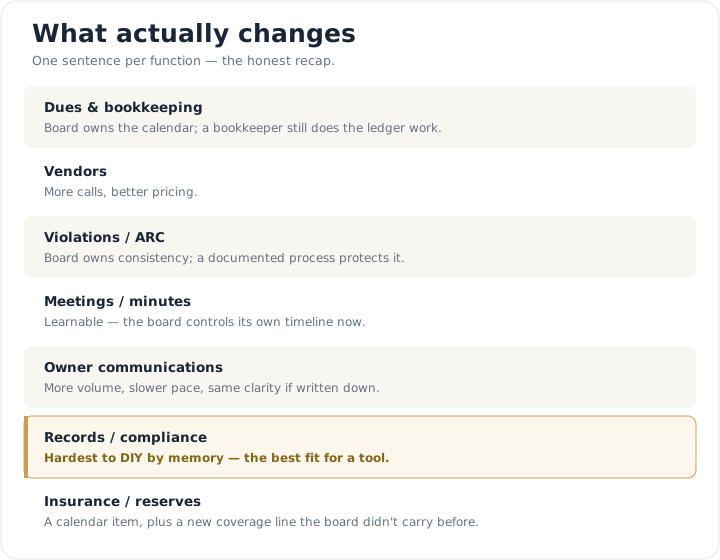
What actually changes, in one sentence per function
- Dues and bookkeeping: the board owns the calendar; a bookkeeper still does the ledger work.
- Vendors: more calls, better pricing.
- Violations/ARC: the board owns consistency; a documented process protects it.
- Meetings/minutes: learnable, and the board controls its own timeline now.
- Owner communications: more volume, slower pace, same clarity if written down.
- Records/compliance: the hardest thing to DIY by memory — and the best fit for a tool.
- Insurance/reserves: a calendar item, plus a new coverage line the board didn't carry before.
Manageable with the right systems
None of this is a reason to stay managed if your board has the time and the will — and none of it is a reason to feel behind if you decide self-managing isn't the right fit this year. The honest answer is the useful one: self-management is real work, distributed across real people, and it's manageable when the board is honest about the trade going in rather than discovering it three months after the transition.
If you're sizing up the decision, our self-managed HOA board checklist walks through every task this post touched on in more depth, and the fee calculator puts a real number on what your board is currently paying, annualized — the number worth comparing against the work described above. If the cost side of the decision is where you're stuck, see the full breakdown in self-managed vs. professionally managed HOA cost, and when you're ready to make the move, how to fire your HOA management company the right way covers the transition mechanics so nothing falls through during handoff.
The function that's hardest to replace with willpower alone — knowing what your own governing documents require, on demand, without a manager's memory to lean on — is the specific gap BoardPath was built to close. Upload your CC&Rs, bylaws, rules, and amendments, and ask it a question: you get a cited, hierarchy-aware answer, ranked in the correct order of authority, not a guess. Pair that with violations tracking, meeting minutes, and owner correspondence on your letterhead, and a board can cover most of the list above at one flat price that doesn't climb with your unit count. See it in the live demo, or join the founding cohort if you're ready to run your community with the system already in place.