The short answer
The headline fee is not the real number. As a rough industry ballpark that varies by market, a small-to-mid-size community might see a flat monthly fee somewhere in the $1,200 to $2,500 range, or a per-door rate in the single-to-low-double digits per unit — treat that as a starting point for your own research, not a quote. The base fee buys a defined scope of work; setup, portal, mailing, transfer, and special-project charges are billed on top of it. To find your all-in cost, read past the summary to the fee schedule addendum and pull the association's actual additional-service billing from the last 12 months.
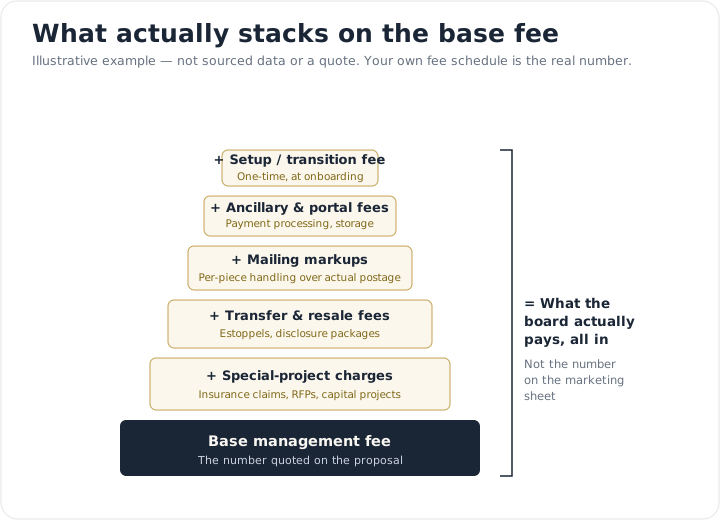
Ask a board how much its management company costs, and most will quote the line item on the budget — the monthly management fee. Ask what the community actually paid the company last year, all in, and the number is almost always higher. Not because anyone did anything wrong. Because HOA management company cost is rarely just the base fee. It's the base fee plus a stack of smaller charges — setup, portal access, mailing markups, transfer fees, "special projects" — that each look small on their own and add up to real money over a multi-year contract.
This isn't an argument that management fees are unfair. Good management work is worth paying for. The problem is opacity, not price: a board that can't see its true all-in cost can't judge whether it's getting a fair deal, can't compare offers apples-to-apples, and can't weigh self-managing against staying managed with real numbers. This post walks through the fee structure, the charges that don't show up in the advertised rate, how to read your agreement to find them, and what the self-managed alternative actually costs instead.
This is general information for board members, not legal or financial advice. Every figure below is a typical market range, not a guarantee — fee structures vary by management company, region, and contract, and contract law and required disclosures vary by state. Read your own agreement and confirm anything material with counsel before you act.
The base management fee — what boards typically see
Management companies usually price one of two ways: a flat monthly fee for the association, or a per-door (per-unit) monthly rate. As a rough industry ballpark — your market varies — a small to mid-size community might see a flat fee somewhere illustratively in the $1,200–$2,500-a-month range, or a per-door rate in the single-to-low-double digits per unit; treat both as a starting point for your own research, not a quote. Scale matters — a 40-unit community and a 400-unit community are not buying the same service, and neither is necessarily overpaying at a higher headline number.
The base fee is also the easiest number to shop against — it's on the marketing sheet, it's the first thing quoted on a discovery call, and it's what most boards compare when they solicit proposals. That's exactly why it's not the whole picture. The base fee buys a defined scope: a set number of site visits, a monthly financial package, a certain number of owner communications. Everything outside that defined scope is usually billed separately — and that's where the real comparison has to happen.
The fees that don't show up in the base rate
This is the part boards usually don't budget for, and it's the source of most "we thought we were paying less than this" conversations. None of it is concealed — it's typically disclosed somewhere in the contract's fee schedule. It's hidden in the sense that it doesn't appear on page one, and a board that only reads the headline fee never sees it coming.
- Setup or transition fees. A one-time charge to onboard the association — building out the chart of accounts, migrating owner records, setting up the portal. As a rough ballpark, boards often see this land somewhere in the low-to-mid four figures, charged once at the start of the relationship (and sometimes again if the association later switches software or vendors within the same company) — but get the actual number from your own proposal, not this range.
- Ancillary and portal fees. Owner portal access, online payment processing (often a per-transaction or percentage surcharge passed to the homeowner, but sometimes to the association), and document storage. Individually small; across a full roster of owners paying assessments online every month, the aggregate is not.
- Mailing markups. Paper statements, violation notices, meeting notices, and ballots typically carry a per-piece handling charge on top of actual postage. It's a legitimate cost to recover — printing, stuffing, and mailing take staff time — but the markup over the actual postage cost varies widely between companies, and it's rarely broken out clearly on the fee schedule.
- Transfer and resale fees. Estoppel certificates, resale disclosure packages, and transfer-related paperwork triggered every time a unit sells. These fees are usually paid at closing rather than by the association directly, but they matter to the board because they land on your homeowners and because the company frequently keeps a meaningful share as pure margin on top of the actual document-prep cost.
- "Special project" charges. Anything outside the base scope of work — an insurance claim, a collections matter, an RFP process, a large capital project — often gets billed hourly or as a flat add-on. This is the category most likely to surprise a board mid-contract, because the triggering event (a burst pipe, a lawsuit, a reserve study) wasn't on anyone's radar at signing.
None of these charges make a management company a bad actor — some are legitimate cost-recovery for real work. The issue is that a board evaluating HOA management company cost against the base fee alone is comparing the wrong number, and a board comparing two proposals on base fee alone may be picking the thinner disclosed scope, not the better deal.
How to read your management agreement for the true all-in number
Getting to the real number takes reading past the first page. A few places to look:
- Find the fee schedule addendum, not just the summary paragraph. Most agreements bury the itemized rates — per-transaction, per-project, per-page — in an exhibit at the back.
- Ask for the association's actual additional-service billing from the last 12 months, not the rate card. The rate card tells you what could be charged; last year's invoices tell you what actually was, which is the number that matters for budgeting.
- Check how the base fee scales. Is it a flat number, or does it increase automatically as units are added or as an escalation clause (a fixed percentage, or tied to an index) kicks in at renewal? An escalator that looked minor in year one compounds over a multi-year term.
- Check who gets billed — the association, or individual homeowners at closing or point of transaction. Transfer and portal fees often land on owners, not the HOA's operating budget, but they're still part of the true relationship cost and worth knowing before an owner calls the board confused about a charge nobody explained.
- Look for exclusivity clauses — a requirement to use the company's preferred mail house, bank, or vendor list. Not automatically a problem, but it can make any one piece of the cost harder to shop independently.
What it adds up to over a multi-year contract
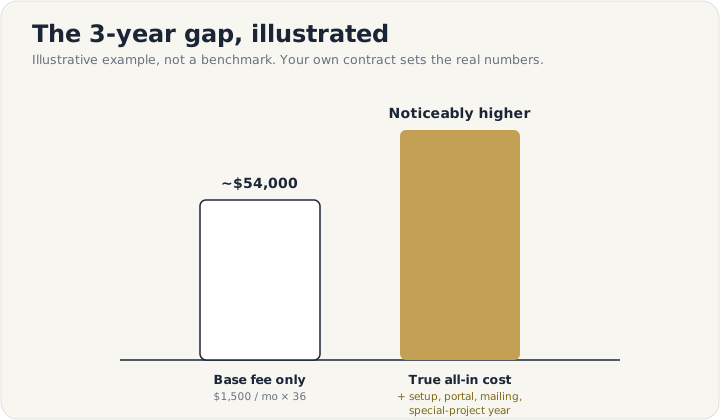
Run the math on a typical multi-year term and the gap between "the fee we quoted the board" and "what we actually paid" tends to widen. Illustrative example: a community paying roughly $1,500 a month in base fees is looking at $54,000 over three years before a single additional charge. Add a one-time setup fee, three years of portal and mailing fees, and a modest year of special-project billing, and the true three-year total commonly runs noticeably higher than the base-fee math alone suggests. That gap is exactly what a board needs visibility into before signing a multi-year term, not after — and it's a reason to ask for the full number, not to assume the worst of every proposal.
What self-managing costs instead
The other side of this comparison is what a board takes on if it moves the work in-house. It is not free: self-management replaces a management fee with real board time plus a smaller stack of paid functions most communities still need — typically a part-time bookkeeper, a CPA for the annual return, and an attorney on call for compliance questions and enforcement. Those costs are usually a fraction of a full management fee, but "usually a fraction" is not "zero," and a board that skips budgeting them is trading one blind spot for another. We've covered that comparison in full in Self-Managed vs. Professionally Managed HOA: The Real Cost Breakdown.
The other piece is tooling — and here the gap has closed faster than most boards realize. A management fee buys, among other things, software the board doesn't otherwise have: an accounting system, an owner portal, a way to answer "what do our governing documents actually say about this" without paging through a 90-page PDF. Those functions no longer require an enterprise contract. Inexpensive, purpose-built tools now cover accounting, e-payments, and communications individually — and BoardPath covers the piece none of them do: a cited, hierarchy-aware answer to governance questions, straight from your own CC&Rs, bylaws, and rules, at one flat price that doesn't climb with your unit count the way a per-door management fee does.
See your own number before you decide anything
The honest starting point for any of this isn't a market range — it's your own contract and your own budget. We built a free management-fee calculator to make that fast: plug in your base fee, unit count, and the ancillary charges from your own fee schedule, and see your true all-in cost — plus a side-by-side estimate of what self-managing would likely save once the hidden costs of that path are subtracted too. It won't tell you what to decide. It will tell you the real number to decide from.
If self-managing turns out to be the right move, the transition itself has its own risks worth planning for — covered in How to Leave (or Fire) Your HOA Management Company the Right Way. And whichever way the board leans, BoardPath is built to be the system that replaces the governance functions a management company provided — cited answers from your own documents, violations tracking, meeting minutes, and owner letters on your letterhead, all at one flat price. See it in the live demo, or join the founding cohort if you're ready to run your community on real numbers instead of a headline fee.