The short answer
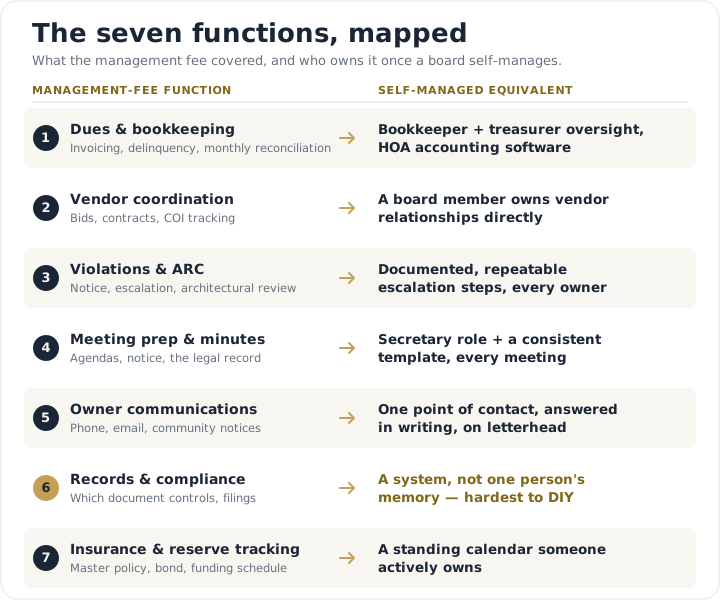
A management company bundles seven recurring functions into one fee: dues collection and bookkeeping, vendor coordination, violation and architectural review processing, meeting prep and minutes, owner communications, records and compliance, and insurance and reserve tracking. Some communities pay for all seven; others pay for a partial-service package covering only a few. Most of the seven are ordinary work a board can absorb or buy piecemeal — the hardest to replace is records and compliance, meaning an answer on demand to what your own documents require, because that is institutional knowledge rather than a task you can put on a calendar. A bookkeeper, a CPA for the annual return, and an attorney on call are honest line items to budget for either way.
Most boards sign a management contract, pay the invoice every month, and never actually see the list of what's inside it. That's not a knock on management companies — it's just how the relationship usually works. The board delegates, the manager executes, and the details stay behind the curtain. The problem shows up later, when a board is deciding whether to renew, negotiate, or leave, and realizes it can't answer a basic question: what does an HOA management company actually do, day to day, for the fee?
This post pulls back that curtain. Not to talk anyone into or out of a management company — plenty of them do this work well and earn every dollar of the fee — but because a board that can't name the functions can't evaluate the service, negotiate the contract, or make an honest decision about self-managing. Below is the real day-to-day job, function by function, and next to each one: how a self-managing board handles it, and where a tool actually helps versus where it's just work.
This is general information for board members, not legal advice. Which of these duties are governed by statute, and how, varies significantly by state — check your state's HOA or condo statute and your own governing documents, and confirm anything with legal consequences with counsel.
The seven functions inside a management fee
Strip away the sales language and a management contract is really a bundle of seven recurring functions. Some communities pay for all seven; some pay for a partial-service package covering only a few. Knowing the full list is the point — you can't tell what you're paying for, or what you'd be taking on, without seeing it whole.
1. Dues collection and bookkeeping
The manager invoices assessments, tracks who's paid, follows the delinquency process, and reconciles the bank accounts every month — operating and reserve funds kept separate. They typically also prepare the annual budget draft, coordinate the yearly financial review or audit, and pull together documentation for the association's tax filing.
How a self-managing board handles it: this is usually the function boards least want to do entirely by hand, and for good reason — reconciliation errors and commingled funds are how associations get into real trouble. Most self-managing boards keep a part-time bookkeeper for the monthly ledger work and a CPA for the annual return, with the treasurer providing oversight rather than doing every entry personally. Accounting software built for HOAs (not general small business tools) handles the reconciliation and reporting; a tool doesn't replace the bookkeeper, but it does replace the spreadsheet chaos that causes most of the errors.
2. Vendor coordination
Soliciting bids, negotiating contracts, scheduling routine maintenance, and being the point of contact when a vendor's insurance certificate lapses or the landscaper misses a mow — this is constant, low-glamour work that a manager absorbs almost invisibly.
How a self-managing board handles it: someone on the board — usually whoever chairs the grounds or maintenance role — owns vendor relationships directly. It's more phone calls than most volunteers expect, but it's also where self-managing boards report real savings: no markup on vendor invoices, and direct leverage to shop bids competitively. A shared vendor log with contract dates, insurance expiration, and contact info prevents the classic miss — a certificate of insurance quietly lapsing without anyone noticing until there's a claim.
3. Violation and ARC (architectural review) processing
The manager fields the complaint, documents the violation, sends the notice, tracks the escalation timeline, and processes architectural review applications against the community's standards — consistently, for every owner, every time.
How a self-managing board handles it: consistency is the entire game here. Many states require some form of notice and an opportunity to be heard before certain enforcement actions — the specifics vary by state and by your governing documents, so confirm both before acting. The real risk for a self-managing board isn't the paperwork; it's applying the rule differently to a friend on the board than to a stranger down the street, which is exactly the fact pattern behind a selective-enforcement claim. A documented, repeatable violation process — the same steps, the same timeline, every time — is what protects the board more than any single notice does.
4. Meeting prep and minutes
Agendas, notice mailed on time, materials prepared in advance, and minutes drafted afterward that hold up as the association's legal record — not a summary of the vibe in the room.
How a self-managing board handles it: this one is genuinely learnable. The secretary role carries it, and the skill is more about discipline than expertise — minutes record what was decided, not what was discussed. A consistent template and someone who owns it every meeting closes most of the gap a manager used to fill here.
5. Owner communications
Answering the phone, responding to email, sending community-wide notices, and being the buffer between the board and 40 to 200 individual owners with individual questions.
How a self-managing board handles it: this is the function that surprises boards the most — it's simply a lot of volume. Self-managing boards that hold up well tend to designate one point of contact (rotating or fixed) and answer everything in writing, on association letterhead, so there's a record instead of "the board said so at the pool." It won't feel instant the way a management company's office line does, but owners generally accept slower responses from volunteers if the answers are clear and consistent.
6. Records and compliance
Keeping the corporate records straight — governing documents, amendments, minutes, correspondence, the owner roster — and staying on top of state filings, insurance renewals, and other recurring compliance obligations the association can't afford to miss.
How a self-managing board handles it: this is a memory problem more than a skill problem. The manager's real value here was rarely expertise in any one document — it was simply knowing where everything lived and what controlled what when the CC&Rs, bylaws, and rules didn't quite agree, a question covered in more depth in which HOA document controls. That's the piece boards feel the sharpest the moment a manager's institutional memory walks out the door — and it's the piece a tool is best positioned to replace, because it's fundamentally a retrieval problem, not a judgment-call problem.
7. Insurance and reserve tracking
Confirming the master policy and fidelity bond stay current, collecting certificates of insurance from vendors, and tracking the reserve study's funding schedule against what's actually been set aside for major repairs.
How a self-managing board handles it: insurance renewal dates and reserve funding milestones belong on a standing calendar someone actively owns — not a mental note. Reserve studies themselves are worth understanding on their own terms; see our breakdown of how a reserve study works. This is a case where a tracked, recurring reminder does most of the work a manager used to do by habit.
The honest bottom line
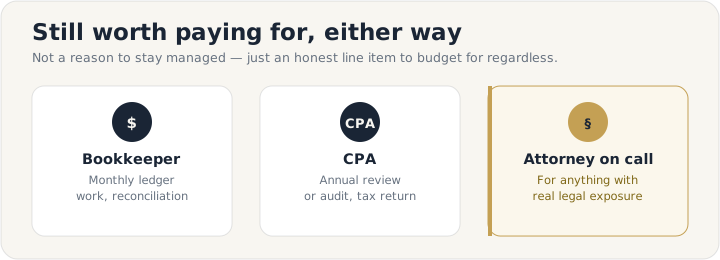
Look at that list again. Most of it isn't specialized expertise — it's recurring, disciplined work that a motivated board can absorb, function by function, with the right person in the right seat and the right tool behind them. A couple of pieces genuinely benefit from paid outside help regardless of who's managing — a bookkeeper for the ledger, a CPA for the return, an attorney on call for anything with real legal exposure. That's not a reason to stay managed; it's just an honest line item to budget for either way.
What most boards actually miss isn't any single task on this list. It's the thing a manager provided without anyone noticing: an answer, on demand, to "what do our own documents require here?" That's not a task you can put on a calendar or hand to a bookkeeper — it's the institutional knowledge that used to live in one person's head, and it's the piece that's hardest to replace with willpower alone.
Where to go from here
If you're standing at this decision, don't guess — work through it deliberately. Start with our self-managed HOA board checklist for the complete task-by-task list, weigh the real numbers in self-managed vs. professionally managed HOA cost, and if you're already leaning toward a change, how to fire your HOA management company the right way walks through the transition without the common mistakes. We're also building a short, honest "should we self-manage?" readiness checklist for boards weighing exactly this decision — watch for it, or start with the self-assessment already live on our self-manage guide in the meantime. The full set of tools boards use to run lean is gathered at our resources hub.
The function on this list that's hardest to DIY isn't bookkeeping or vendor calls — it's knowing what your own governing documents actually require, in the moment you need to know it. That's the specific gap BoardPath was built to close: upload your CC&Rs, bylaws, rules, and amendments, and ask it a question — you get a cited, hierarchy-aware answer ranked in the correct order of authority, not a guess. Pair that with violations tracking, meeting minutes, and owner correspondence on your letterhead, and a board can cover most of the list above without flying blind. See it in the live demo, or join the founding cohort if you're ready to run your community with the system already in place.