The short answer
The readiness check is five yes-or-no questions covering your community's size, whether the work would land on several willing volunteers or on just one, whether anything urgent like litigation or a reserve shortfall is already in motion, whether at least one board member is comfortable with everyday software, and whether the real reason you are considering the change is a fair one. It takes about two minutes and needs no email or account. An active crisis deliberately caps the result no matter how the other four score, because self-managing while also digging out of litigation or a reserve problem is not the same decision as self-managing a stable community.
Most boards don't need another 2,000-word article to decide whether to self-manage. They need five honest questions and a straight answer. That's what this is: an HOA self-management readiness check that tells you, right now, in about two minutes, whether your board looks like a good candidate for self-management, a maybe-with-conditions, or a "get help first."
If you want the full decision framework — the real trade-offs, the functions self-management actually requires, when staying managed is the smarter call — that's covered in depth in Should Your HOA Self-Manage? A Decision Framework for Boards. This post is shorter on purpose. It's built around the checklist itself, because for a lot of boards the honest self-scoring is more useful than another 2,000 words of theory.
Take the HOA self-management readiness check
It lives on our self-managed guide — five yes/no questions, no email required, no account, results in under two minutes.
Take the 2-minute readiness check →
It asks about the things that actually predict whether self-management goes well: your community's size, whether the work would land on a few willing volunteers or just one, whether anything urgent is already in motion, whether at least one board member is comfortable with everyday software, and whether the real reason you're considering this is a fair one. Answer all five and you'll get one of three honest reads — a strong fit, a likely fit with some weak spots to shore up first, or a "get help first" flag. There's no version of this quiz that tells every board to self-manage. That's the point.
Why these five questions, specifically
The checklist isn't arbitrary. Each question maps to one of the factors that actually separates boards that self-manage well from boards that struggle.
Size. A smaller community carries a lighter decision-and-compliance load — fewer units means fewer moving parts across enforcement, finances, and meetings in any given month. That doesn't mean a larger community can never self-manage, but the honest math gets harder as the roster grows, especially past the point where amenities and shared infrastructure get complex.
Board bandwidth — not just willingness. This is the one boards get wrong most often. Self-management isn't a job for one heroic volunteer; it's a set of ongoing functions — governance answers, obligations tracking, meetings, enforcement, records, communication — that need more than one person able to carry them. A board with three engaged directors and a treasurer who can read a reconciliation is in a different position than a board with one person doing everything and four names on a roster. Willingness alone doesn't answer the mail; capacity does.
Current pain — the "no active crisis" check. Litigation, a major construction defect, or a reserve fund already in trouble changes the calculus entirely. Self-managing while also digging out of one of those isn't the same decision as self-managing a stable community. This is deliberately the one factor that caps the result no matter how the other four score — a board mid-crisis shouldn't be told "go for it," and a check that would tell them that isn't honest.
Comfort with tools. Self-management works when at least one board member is comfortable using everyday software — for governance answers, records, and correspondence — instead of everything living in one person's inbox and memory. This isn't a high bar. It's the difference between a system the next board can inherit and a system that walks out the door when one volunteer burns out.
The real motivation. Wanting more control and transparency than a management company currently provides is a legitimate, healthy reason to consider self-managing. Wanting to punish a management company, or assuming self-managing means "the same job for free," usually isn't a stable foundation for the decision. Boards that self-manage successfully are opting into ownership, not just opting out of a fee.
What your result actually means
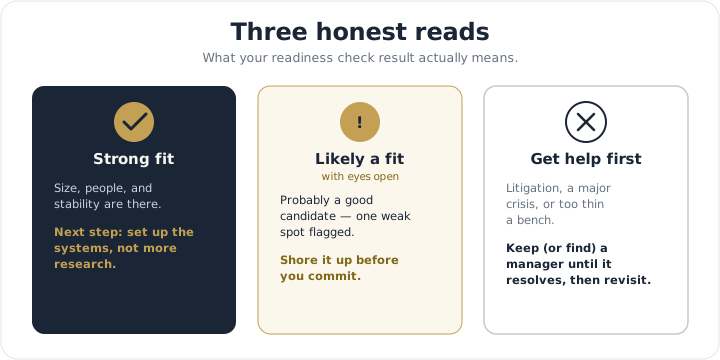
Strong fit. Your board has the size, the people, and the stability to make self-management work. The next step isn't more research — it's setting up the systems (governance knowledge, obligations tracking, records, correspondence) so the transition doesn't rely on any one person's memory.
Likely a fit, with eyes open. You're probably a good candidate, but the check flagged a weak spot — maybe bandwidth, maybe the tooling comfort question. That's worth shoring up before you commit, not a reason to abandon the idea. A board that self-manages with a plan for its weak spot does fine; a board that ignores the weak spot usually finds out about it the hard way, six months in.
Get help first. If litigation, a major construction or reserve crisis, or too thin a bench flagged your result, that's not a failure — it's the honest read most guides skip because they're trying to sell you something regardless of your answer. Keep (or find a better) manager until the complication resolves, and revisit the check afterward.
Whatever you land on, this is general information for board members, not legal advice — association obligations around notice, meetings, records, and enforcement vary by state and by your own governing documents, so confirm anything with legal consequence against your CC&Rs, bylaws, and rules, and bring in counsel where it matters.
Where to go from your result
If you scored a strong or likely fit, the natural next stops are the practical ones: what the full job looks like day to day in the self-managed board checklist, the real dollar comparison in self-managed vs. professionally managed HOA cost, and the transition mechanics in how to fire your HOA management company the right way. For the full reasoning behind the checklist itself — the honest case for and against self-management, and when staying managed is genuinely the smarter call — read Should Your HOA Self-Manage? A Decision Framework for Boards.
A readiness check can tell you whether your board is a good candidate. It can't do the job for you once you decide. That's what BoardPath is built for: the governance knowledge a manager used to hold, now cited to your own documents and available on demand; obligation reminders so nothing quietly lapses; consistent recordkeeping instead of one person's inbox. If your board scored well, see it in the live demo or join the founding cohort — the system is ready before you need it, not after something slips.