The short answer
Compliance for a self-managed board covers six areas: meetings, notice, and quorum; records and retention; fair and consistent enforcement; financial controls and reserves; required disclosures; and insurance. None of them are exotic — each is a process that runs on a calendar, a checklist, and the habit of writing things down as the work happens rather than reconstructing it later. Put every deadline on one calendar pulled from your bylaws and your state statute, with reminders set well ahead of each one. On the financial side, reconcile monthly with someone other than the check-writer reviewing it, keep operating and reserve funds genuinely separate, require dual approval on reserve disbursements, and get an annual review from an accountant who works with community associations.
This is general information for board members, not legal advice. Requirements around notice, records, enforcement, and disclosures vary significantly by state and by your own governing documents. Confirm your state's current requirements and your CC&Rs, bylaws, and rules before you rely on anything here, and bring in counsel on anything with real legal or financial consequences.
If your board just left — or is thinking about leaving — a management company, one worry tends to sit underneath every other question: what if we miss something? A manager's real value was never the phone calls or the vendor rolodex. It was the quiet certainty that somebody was watching the obligations a board doesn't get to skip — notice deadlines, records requests, insurance renewals, the paperwork nobody thinks about until it's overdue.
Here's the reassurance worth sitting with: staying compliant isn't a talent a manager had and your board doesn't. It's a system — a short, repeatable set of habits any organized board can run. This post lays out that system across the areas that matter most: meetings and notice, records, enforcement, financial controls, disclosures, and insurance. Self-managed boards handle this successfully every day. The ones that do it well didn't hire a smarter person — they built a better checklist.
The compliance surface a self-managed board has to cover
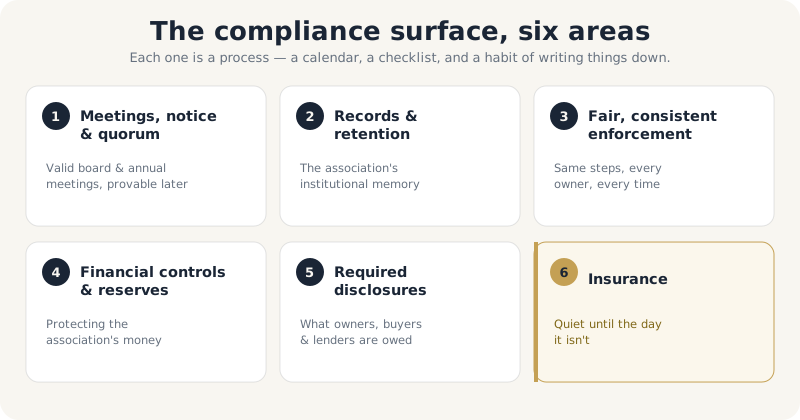
Compliance sounds abstract until you break it into the actual jobs. For most HOAs and condominiums, it comes down to six areas:
- Meetings, notice, and quorum — running valid board and annual meetings
- Records and retention — keeping and producing the association's official record
- Fair, consistent enforcement — applying the rules the same way to every owner
- Financial controls and reserves — protecting the association's money
- Required disclosures — giving owners, buyers, and lenders the information they're owed
- Insurance — keeping the association's risk covered
None of these are exotic. Every one of them is a process, and every process below can be run on a calendar, a checklist, and a habit of writing things down.
1. Meetings, notice, and quorum
A board meeting or annual meeting that skips required notice, or that proceeds without quorum, can produce decisions — even elections and budgets — that get challenged later. The fix is procedural, not legal expertise:
- Put every notice deadline on one calendar — board meetings, the annual meeting, election timing — pulled from your bylaws and your state's statute, and set reminders well ahead of each one.
- Confirm quorum before you open business, and record how you confirmed it in the minutes.
- Treat minutes as a legal record, not a summary. Capture the date, who attended, every motion with its mover, seconder, and vote outcome, and any action items — every time, not just when something contentious happens.
- Know the line between what can happen in open session versus a closed one. That line varies by state and by your documents, so check yours before you decide to go behind closed doors.
For the mechanics of each of these, see HOA annual meeting requirements, how to take HOA meeting minutes, and open meetings and executive session. If proxies come into play at your annual meeting, proxy and voting rules covers that separately.
2. Records and retention
An association's records are its institutional memory — and, in a dispute, its evidence. A manager used to be the de facto keeper of that archive. Without one, the board has to be deliberate about it:
- Keep the corporate record organized and complete: governing documents and every recorded amendment, minutes, contracts, financials, and the owner roster.
- Respond to owner inspection requests promptly and correctly. Owners generally have some right to inspect association records; the exact scope, timing, and any permitted redactions vary by state and by your documents, and getting this wrong can carry real consequences — check yours before you say no to a request.
- Respond to resale, estoppel, and closing requests from title companies and closing attorneys. These typically run on deadlines set by state law, so a slow response can hold up someone's home sale — confirm your state's timing and don't let these sit in an inbox.
- Never let "amended once" become "amended, but nobody's sure which version is current." Know which document controls when your CC&Rs, bylaws, and rules seem to overlap or conflict.
3. Fair, consistent enforcement
Enforcement is where compliance and fairness overlap most directly — and where a self-managed board is most exposed if it isn't careful. The two failure modes are the same everywhere: skipping a required step, and applying a rule to one owner but not another.
- Run every violation through the same documented steps, every time — typically a courtesy notice, a formal notice, and a hearing step before anything escalates to a fine. Many states require notice and a hearing before a board can impose a fine; check your state's HOA or condo statute and your own governing documents, and confirm the specifics with counsel.
- Document the file as you go — dates, notices sent, photos, owner responses — so the record exists before you ever need it.
- Apply the rule the same way to every owner. A board that lets one owner's violation slide while enforcing the identical rule against a neighbor hands that neighbor a real defense. See selective enforcement for how that trap plays out, and the HOA violation process for the full escalation sequence.
4. Financial controls and reserves
Money is a common area where self-managing boards get into trouble — not from bad intentions, but from thin oversight. A short list of controls closes most of the gap:
- Reconcile every account monthly — operating and reserve separately — and have someone other than the person who writes checks review the reconciliation.
- Keep operating and reserve funds in genuinely separate accounts, never commingled, even temporarily.
- Require dual approval on reserve disbursements so no single person can move that money alone.
- Adopt a budget before the fiscal year starts, and require board approval for anything outside it. (See HOA budget basics for self-managed boards.)
- Keep a current reserve study and fund toward its plan — a stale or missing study is how a board ends up hitting owners with a surprise special assessment instead of a planned one. More on the study itself in our reserve study guide.
- Get an annual CPA review or audit, using an accountant who actually works with community associations. Some states and governing documents set a size threshold that requires this — check yours, and do it anyway if you're holding meaningful reserves.
5. Required disclosures
Boards owe certain information to owners, buyers, and sometimes lenders, on a schedule that isn't always intuitive. This is one of the easiest areas to let slip precisely because nothing visibly breaks the day you miss it — the cost shows up later, in a stalled closing or an angry owner.
- Know what you owe owners routinely — budgets, financial statements, and meeting notices, at minimum — and deliver them on the same schedule every year so it becomes a habit rather than a scramble.
- Know what you owe a buyer at resale. Resale and estoppel disclosures often have their own content requirements and deadlines, separate from routine owner communication; confirm what your state and documents require before a closing is waiting on you.
- Put the disclosure calendar next to your meeting-notice calendar. They're both "the clock started and someone has to notice" problems, and they're easiest to miss for the same reason.
6. Insurance
Insurance compliance is quiet until the day it isn't. A short annual routine keeps it that way:
- Renew the master policy every year and reassess coverage as replacement costs change — don't just auto-renew the same number.
- Carry fidelity/crime coverage for anyone who handles association funds. When a management company's bond leaves with them, a self-managed board's own money has thinner protection unless the board replaces it directly.
- Collect a certificate of insurance from every vendor before work begins, and track expiration dates so a lapsed COI doesn't sit unnoticed for months.
The system, not the person
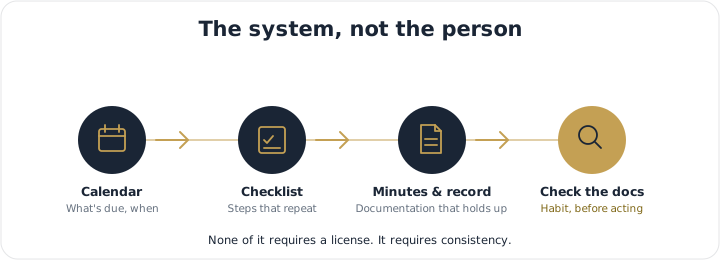
Look back across all six areas and a pattern shows up every time: a calendar of what's due and when, a checklist for the steps that repeat, minutes and documentation that create a real record, and a habit of checking what the governing documents actually say before acting. None of that requires a management license. It requires consistency — and consistency is exactly what a system is built to protect against a volunteer board's biggest real risk: a good year followed by a distracted one.
That's also the honest limit of any checklist, including this one: it tells you what to track, not what your specific documents and state require in your specific situation. Bring in a community-association attorney before anything with real legal weight — a fine escalation, a disputed disclosure, a records-request refusal — and keep that relationship on standby rather than scrambling to find one mid-dispute.
Where BoardPath fits
The common thread through everything above is that compliance depends on knowing what your own documents require, and never letting a deadline or an obligation go untracked because nobody happened to remember it. That's the gap BoardPath is built to close: cited, hierarchy-aware answers pulled from your association's own CC&Rs, bylaws, and rules — so a board member can ask "do we need a hearing before this fine?" and get an answer sourced from the board's own uploaded governing documents (and from statute only where a statute has actually been ingested into the corpus), instead of a guess (the exact liability of asking a general chatbot about your CC&Rs) — plus a running obligations tracker so recurring deadlines surface before they're missed, not after. It's not a replacement for counsel on anything that actually turns legal; it's the system that keeps the routine bulk of compliance from ever reaching that point. See it in the live demo, or join the founding cohort.
If you're earlier in the decision, the full picture of what self-managing takes on is in the self-managed HOA board checklist, and who owns which piece of it is in HOA board member roles explained.
<!-- Internal links: hoa-annual-meeting-requirements, how-to-take-hoa-meeting-minutes, hoa-open-meetings-executive-session, hoa-proxy-and-voting-rules, which-hoa-document-controls, selective-enforcement, hoa-violation-process, hoa-budget-basics-self-managed-boards, hoa-special-assessment, hoa-reserve-study, self-managed-board-checklist, board-member-roles-explained — all confirmed status:published in content/blog-drafts/ at time of writing. Plus /demo and /apply. -->