The short answer
Yes, in almost every case. There is no general prohibition on an association running its own affairs — hiring a management company is a choice the board makes, not a requirement to operate. Confirm two things before you assume a clean yes: whether your own declaration or bylaws require professional management, and whether a loan, master insurance arrangement, or development-stage agreement attaches a management requirement. The association's obligations don't change when you self-manage; only who is responsible for meeting them does.
Short answer: yes, it's legal to self-manage an HOA. Most volunteer boards can run their own community without a management company, and thousands already do it. The question isn't really a yes-or-no legal question — it's whether your board can meet the same obligations a manager used to meet on its behalf. That distinction is where most of the anxiety about self-managing actually lives, and it's worth taking apart carefully instead of waving it away.
If your board is weighing whether to leave a management company, the fear underneath the question usually isn't "will we get in trouble for doing this" — it's "will we get something wrong and not know it until it's too late." That's a fair fear. It's also a manageable one.
This is general information for board members, not legal advice. Whether self-management is permitted, and what it requires, depends on your state's HOA or condo statute and your own governing documents — both vary. Confirm your state's current requirements and your CC&Rs, bylaws, and rules before you rely on anything here, and bring in counsel on anything with real legal consequences.
Yes — self-management is legal, and common
There is no general prohibition on a homeowners association or condo association running its own affairs. An HOA board is elected by the owners specifically to govern the association; hiring a management company is a choice the board makes to delegate certain functions, not a legal requirement to operate at all. Most small and mid-size communities are self-managed for exactly this reason — the board simply keeps the functions in-house instead of contracting them out.
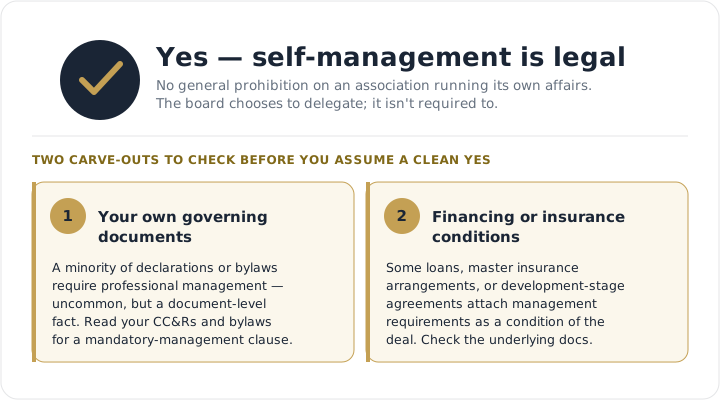
Two carve-outs worth checking before you assume yours is a clean yes:
- Your own governing documents. A minority of declarations, bylaws, or state-specific requirements do require the association to retain professional management, particularly in larger or more complex communities, or communities created under certain development or financing structures. This is uncommon, but it's a document-level fact, not a general rule — read your CC&Rs and bylaws for any mandatory-management clause before you plan a transition.
- Anything financed or insured with conditions attached. Some loans, master insurance arrangements, or development-stage agreements attach management requirements as a condition of the deal. If your community has any of these in play, check the underlying documents, not just the CC&Rs.
Outside those two checks, the legal green light is real. What changes when you self-manage isn't your legal right to do it — it's that every obligation the manager used to carry on the association's behalf now sits with the board directly, and the board is the one accountable for meeting it.
What the board becomes responsible for
When the management company leaves, nothing about the association's underlying obligations changes — only who's on the hook for meeting them. The board becomes directly responsible for the full operating list: governance knowledge (knowing what your own documents require and which one controls), the obligations calendar (meeting notices, elections, insurance renewals, reserve studies, filings), running meetings and producing minutes, enforcing rules consistently, keeping records, handling owner communications, and overseeing the association's funds.
None of that is exotic, and none of it requires a law degree — but it is work, and skipping any piece of it is where legal exposure actually starts. We cover the full operating list in detail in our self-managed board checklist; the rest of this post focuses on the pieces that carry real legal weight.
Where the real legal exposure lives
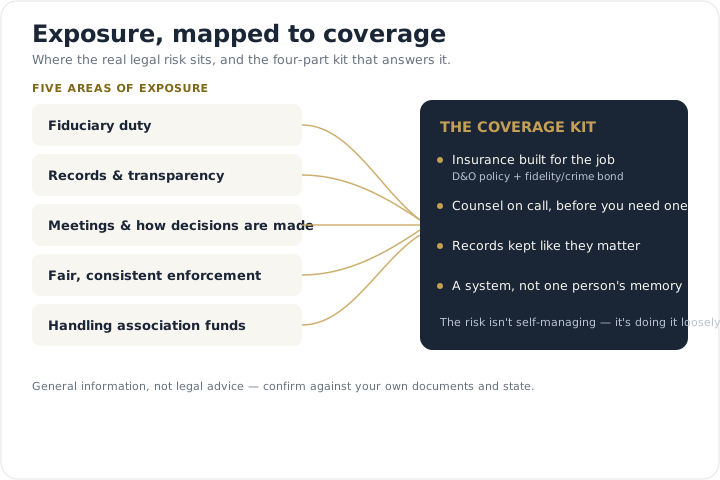
"Is this legal" and "where's the risk" are different questions. Self-management is legal; the risk isn't in the act of self-managing, it's in doing the job loosely. Four areas carry most of the real exposure for a volunteer board.
Fiduciary duty
Board members owe the association a fiduciary duty — a legal obligation to act in the community's best interest, in good faith, and within the scope of their authority, rather than for personal benefit. This is a real and enforceable standard, not a courtesy. A board doesn't violate it by making an honest, informed, good-faith decision that turns out badly; it runs into trouble when a decision is self-interested, made without reasonable care, or made outside the board's actual authority. Understanding this line — and staying on the right side of it — matters more once there's no manager acting as an outside check on board decisions.
Records and transparency
Owners generally have rights to inspect certain association records, and the scope, timelines, and required response vary by state and by your governing documents. A manager used to field these requests as a matter of routine; now the board does, and getting a refusal or a delay wrong can carry consequences. The safer posture is simple: keep organized, complete records, and know what your state and documents actually require before you say no to an inspection request.
Meetings and how decisions get made
Meetings, notice, and minutes aren't paperwork for its own sake — they're the mechanism the law relies on to make sure decisions are made properly and are provable later. Improper notice, a meeting run without quorum, or a decision made outside a properly convened meeting can all be challenged. Minutes are the association's legal record of what the board actually decided, and a thin or missing record is a real vulnerability if a decision is ever questioned. (For the mechanics, see how to take HOA meeting minutes and open meetings and executive session.)
Fair, consistent enforcement
Selective enforcement — applying a rule against one owner while letting the same conduct slide elsewhere — is one of the fastest ways a board loses an enforcement dispute it should have won, and it's a risk that grows without a manager applying the same process every time by default. Many states also require specific notice and process steps before a board can move an enforcement matter to money — check your state's statute and your governing documents, and confirm the process with counsel before you escalate that far. (More on the pattern in selective enforcement, and the full sequence in the HOA violation process.)
Handling the association's funds
The board is handling other owners' money, and that comes with a heightened duty of care — segregating operating and reserve funds, requiring more than one signature on the money that matters, reconciling accounts regularly, and following a written collections process rather than an improvised one. This is less a single legal rule than a pattern: the fewer eyes on the money, the more that duty of care matters, and self-managed boards have fewer eyes on it by default than a managed community does.
How a board covers each of these
None of the exposure above is a reason to stay managed if your board is otherwise a good fit for self-management — it's a list of things to build coverage for before you go. The pattern that works:
- Insurance built for the job. A directors-and-officers policy for the board's decisions, and a fidelity/crime policy covering anyone who touches association funds — a manager's bond doesn't come with you when they leave.
- Counsel on call, before you need one. Not a retainer you use constantly, but a community-association attorney you can call quickly when a records request, an enforcement dispute, or a contract question crosses into legal territory — and a habit of actually calling before, not after.
- Records kept like they matter. Minutes, financials, contracts, and correspondence organized well enough to answer an owner, a closing attorney, or a court on short notice.
- A system instead of one person's memory. The single biggest failure mode in self-managed communities isn't malice — it's a good board relying on one volunteer's memory for what the documents require, and that memory leaving with them.
For where to actually find a vetted insurance broker, attorney, or reserve analyst for each piece of this, see our self-managed HOA stack.
When to call an attorney
Some situations are worth a call regardless of how confident the board feels: a proposed rule or fine that might exceed the board's authority, an owner records request the board is inclined to refuse, an enforcement matter headed toward a lien or real financial consequence, a contract with unusual terms, or any decision where two board members read the governing documents differently and can't agree on which one is right. Calling counsel early on any of these is far cheaper than fixing it after a bad decision is already made.
The bottom line
Self-managing an HOA is legal, common, and — for the right board — the responsible financial choice. The legal exposure isn't in the decision to self-manage; it's in doing the job loosely once you have. Build the coverage — insurance, counsel on call, real records, and a system that doesn't depend on one person's memory — and "is this legal" stops being the anxious question it started as. If your board is still weighing the decision itself, our decision framework and full self-managed checklist are the next stops.
We're building a free self-management readiness checklist under /tools for exactly this moment — a straightforward, scored walk-through of the coverage above, so a board can see precisely where it's solid and where it still has a gap, before it ever leaves a management company. Watch for it as it rolls out to founding boards.
In the meantime, the same instinct — know what your own documents actually require before you act — is the whole idea behind BoardPath. It's the cited, hierarchy-aware brain that tells a self-managing board what its CC&Rs, bylaws, and rules require and which one controls, so the governance knowledge a manager used to carry doesn't have to live in one volunteer's memory. See it in the live demo, or join the founding cohort if your board is already weighing the exit.